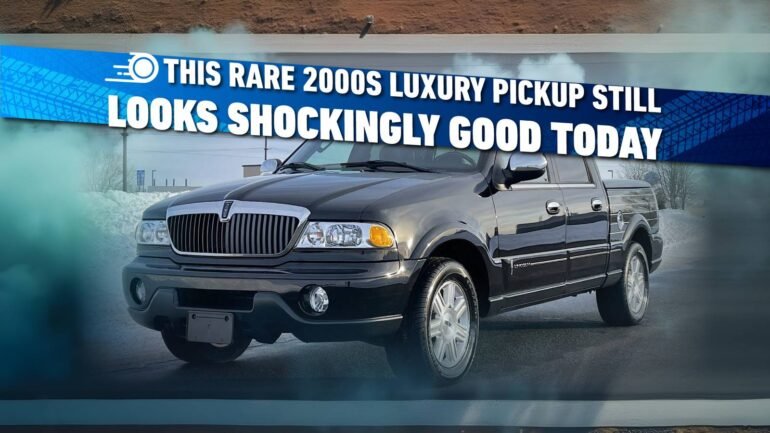
A lot of full-size pickup trucks today are well above the $50,000 mark. In fact, since three of the five best-selling cars in America consist of the Ford F-Series, the Chevrolet Silverado, and the RAM lineup, these vehicles’ high prices are a major contributor to the ever-increasing average transaction prices. These days, pickups are more than just for work. They’ve been packed with features and luxury after each passing generation, wherein we’ve eventually reached a point where the idea of a luxury truck has already been widely accepted.


- Base Trim Engine
-
5.4L InTech V8
- Base Trim Transmission
-
4-speed automatic
- Base Trim Drivetrain
-
Rear-Wheel Drive
- Base Trim Horsepower
-
300 HP @5000 RPM
- Base Trim Torque
-
355 lb.-ft. @ 2750 RPM
- Base Trim Battery Type
-
Lead acid battery
- Make
-
Lincoln
- Model
-
Blackwood
However, did you know that the idea of luxury trucks wasn’t fully accepted in the early 2000s? This is due to a variety of factors, ranging from consumer perception and preferences, all the way to the economic conditions that led to their ultimate demise. One of those luxury pickups that had a very early demise is the Lincoln Blackwood—a model that was produced for such a short time, there aren’t a lot of them that exist on the road today.
A Segment-Bending Luxury Truck

The Lincoln Blackwood is the brand’s first attempt at making a luxury pickup. It had a lot of unique features and traits that helped set itself apart, and one of those is what you already see from the outside. Though it is a rare luxury truck, it isn’t prohibitively expensive in the used market, though it is not cheap, either, as you’ll see with this recently-sold example at Bring a Trailer for $30,250.
Any Color You Want, As Long As It’s Black

Remember Henry Ford’s famous line regarding the Model T? He said that you can get it in “any color the customer wants, as long as it’s black”, but I think he somehow also meant that in the Lincoln Blackwood. Like the Model T, you can only get this car in black, as it complements the simulated black African wengewood panels with aluminum strakes on the bed’s exterior.
This design choice was meant to evoke the “woodie” wagons of the past, namely the Ford LTD Country Squire and Colony Park. As for the interior of that bed (yes, it wasn’t just a simple tub), it was fully carpeted and lined with polished aluminum. It even had LED lighting, and the bed was fully sealed, effectively transforming it into a massive 26 cubic feet of trunk space.
Capitalizing On The Navigator’s Success

The motivation for Lincoln to create the Blackwood was due to the success of the Navigator. By sharing its front-end design with the popular SUV, the Blackwood was met with nearly universal public acclaim when it was shown as a concept at the 1999 North American International Auto Show. Amazingly, the Lincoln Blackwood underwent minimal changes from concept to production, but there were a few changes in order for mass production to be feasible.
The reason for going the simulated wood exterior route was due to production cost constraints. The wheels were also downsized from 19 to 18 inches, while four-wheel drive (4WD) was not offered in order to maintain its well-proportioned low ride height. It even had a unique monoleaf spring rear suspension that was combined with air suspension for a supple ride whilst maintaining a high towing capacity. Of course, with the bed already fully sealed, there is no way for you to haul tall cargo.
Why The Lincoln Blackwood Failed

Of course, at this point, you are probably aware that it wasn’t a commercial success. Only 3,383 units were sold, 50 of which were a Neiman Marcus Edition. This makes it the rarest Lincoln model ever produced.
It Wasn’t Good At Being A Proper Pickup Truck

If you’re in the market for a truck, you probably want the ability to haul heavy cargo, regardless of its height. Due to the enclosed cargo bed, you essentially got the world’s biggest trunk—great if it were a sedan, but not if you intend to actually do truck-related stuff. Furthermore, the lack of 4WD was almost unacceptable to anyone spending north of $50,000 on a luxury truck.

No 4WD means the lack of a low-range gearbox and the inability to go over the toughest terrain. Oh, and we bet you wouldn’t put your jackhammers or construction tools in the trunk area of the Blackwood, lest you’d be willing to scratch the aluminum panels and the carpeted trims. This is a luxury vanity project, not a luxury truck for the working businessman and CEO.
Lincoln Blackwood Performance Specs
|
Engine |
5.4-liter V-8 |
|
Transmission |
4-speed A/T |
|
Horsepower |
300 hp |
|
Torque |
355 lb-ft |
|
Driveline |
RWD |
|
0-60 MPH |
9.2 Seconds |
|
Top Speed |
83 mph |
|
Towing Capacity |
8,700 Pounds |
|
Payload Capacity |
1,200 Pounds |
It did have great towing capacity, though. At 8,700 pounds, it may not be the best vehicle to haul your dirty gear, but it’s the poshest vehicle at the time that will allow you to tow your trailer or a racecar to the track. Thank the 5.4-liter InTech V-8 under its hood, pushing out 300 horsepower and 355 pound-feet of torque. Together with a four-speed automatic that drove the rear wheels, this vanity project would’ve been capable of hauling more than its 1,200-pound max payload if it came with a taller ride height and an actual bed.
And, Unfortunately, It Wasn’t Good Being An SUV

So it fails at being a proper truck, but what about at being a proper SUV? Well, with an SUV’s two-box design, you are able to have a ton of interior space and cargo area—perhaps even three-row seating. Unfortunately, what you get with the Lincoln Blackwood is the usability of a huge four-door sedan that’s neither as practical as an SUV nor as flexible and capable as a proper pickup. To be fair, its interior succeeds in being a true luxury vehicle. The interior was upholstered in plush Connolly leather with heating and cooling for the front seats, along with every single luxury feature that Lincoln could throw at the Blackwood at the time. Some of those features included:
- A sunroof
- A premium sound system with a CD changer
- Multi-zone automatic climate control
- Power-adjustable front seats
Only one optional feature was offered, and that was Ford’s first take on an infotainment system with a five-inch LCD screen. This infotainment came with a voice-activated cellphone (wow, what a time we live in the 2000s) and built-in GPS.
It Paved The Way For Luxury Trucks

Though the Lincoln Blackwood was a commercial failure, the brand’s next model, the Mark LT, had more success. However, it only lasted for one generation. Where it had greater popularity was, in all places, Mexico, where they even got a second-generation model. The Mark LT was officially discontinued by 2014, and it paved the way for what luxury trucks are today.
Brand Loyalty Matters A Lot In The Truck Market

Even when a luxury nameplate makes a highly capable truck, it still doesn’t resonate well with buyers. That’s because truck buyers are extremely brand loyal, and they associate a name with a certain level of ruggedness and toughness. Eventually, the Cadillac Escalade EXT was also discontinued, so today, we no longer have a pickup from a luxury brand.
However, when a nameplate that’s known for capability and toughness does make a luxury pickup, then you can bet that it’ll be very popular among well-heeled truck fans. The brand that initially capitalized on this was RAM with the 1500 Limited beginning in 2019. It was a full-size pickup from a mainstream brand that had a strong focus on offering luxury appointments while maintaining the rough-and-tumble nature of a RAM 1500.
Luxury With Capability Is A Popular Category

And yes, it was met with critical acclaim, both from journalists and customers themselves. In 2019, the RAM truck lineup surpassed the Chevrolet Silverado to become the second-best-selling pickup. Customers also opted for the high-trim variants, as the average transaction price for a RAM 1500 at the time was $50,000, a 50 percent increase from 2010. Since then, Chevrolet has introduced a High Country trim for the Silverado, while Ford has made the Limited trim for the F-150 highly luxurious.
The success of today’s full-size luxury pickups is primarily driven by demand from truck buyers who want something that was first and foremost designed for the rough-and-tumble duties that pickups should be capable of enduring. Luxury, on the other hand, plays a secondary role. The moment that truck manufacturers started to realize this, the idea of a luxury truck as more than just a vanity item has become truly popular since 2019. In fact, it is these premium truck variants that have significantly contributed to the high average transaction prices of vehicles in the past few years. Buyers love them, and so do the automakers themselves, as these are high-margin vehicles. In hindsight, doesn’t that make the Lincoln Blackwood way ahead of its time?