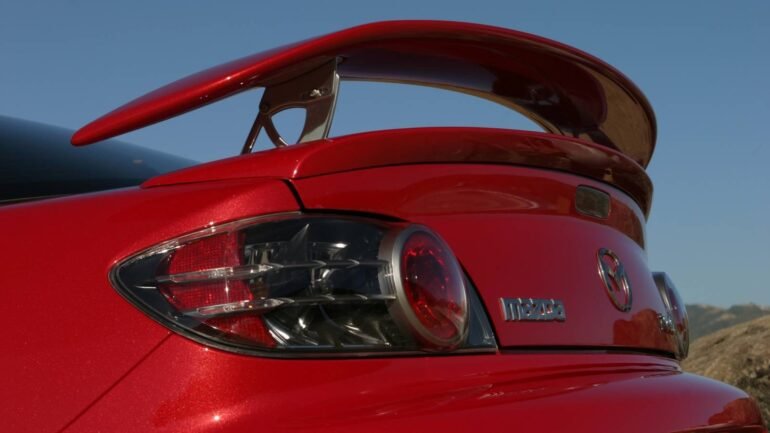
Mazda, as an automaker, perfectly defines persistence. How else would you explain the Japanese automaker sticking to the notorious yet insanely cool rotary engines in its cars when the rest of the world had left them behind? In fact, the last mass-produced rotary-engined car ever made is a Mazda. This is also their most underrated sports car to date. While it’s evident that the secret to the Mazda RX-8’s uniqueness is its rotary engine, there are a lot of other cool supporting features, in the chassis, weight distribution, cabin layout, and exterior design that come together to create one of the most underrated sports cars ever made.
The RX-8 was the successor to the very famous RX-7 and was produced from 2003 to 2012. However, it hasn’t gotten a worthy successor yet. In fact, Mazda has not made a rotary-only mass-market car ever since. The closest it has come is with the Mazda MX-30 EV, which uses the rotary engine as a range extender for the electric powertrain. But frankly, it’s a mundane crossover that got it all wrong.
Unfortunately, the future is hybrid if we ever are to see a rotary mill on a Mazda. But the recently concluded Japan Mobility Show left us hoping for more, as Mazda showcased a drool-worthy Vision X-Coupe. This plug-in hybrid uses a two-rotor rotary turbo engine and an electric powertrain to produce a combined 503 horsepower. Until this becomes a reality, we explain why the RX-8 remains Mazda’s most desirable driver’s car, even after 14 years out of production.

Mazda’s Forgotten Masterpiece: A 2000s Icon Revisited
With big power in an affordable and practical package, the Mazdaspeed3 was a hot hatch ahead of its time, and here’s why it deserves a comeback.
A Compact And Unique Engine Gave The RX-8 An Edge Over Traditional Sports Cars
The Last Mass-Produced Car With A Pure Rotary Engine

The rotary mill in the Mazda RX-8 was a ‘rebirth’ of the Wankel, according to the automaker, and was thus called the RENESIS rotary engine. This mill has strong racing roots, as Mazda uses it extensively in racing, including Pro Formula Mazda and the Grand Am Cup. The greatest advantage that a rotary engine has over traditional mill designs is its compact form factor. In the RX-8, its engine footprint is about 60 percent smaller than a comparable V6 and 40 percent smaller than a four-cylinder.
This alone saves a lot of space and helps cut down on the weight, too. Now, 1.3 liters of engine capacity is minuscule, if it’s a traditional inline layout. But things work differently when it’s a rotary. The RENESIS engine on the RX-8 performs the four strokes of intake, compression, combustion, and exhaust in one rotation of the main shaft. This is achieved by turning a triangular-shaped rotor in a cocoon-shaped combustion chamber to generate power.

In many ways, a rotary engine works similarly to a two-stroke engine. Both lack intake and exhaust valves and require oil to be injected with the fuel. The RX-8 produces 197 horsepower when coupled with the four-speed automatic and 238 horsepower when connected to a six-speed manual. Mazda has tuned the engines differently for each of the transmissions due to reliability and thermal management concerns. The compact form factor gives this mill a high-revving nature, with a peak of 9,000 RPM. Also, due to its aggressive torque curve, the RX-8 needs to be revved high to unlock its true potential.
Engine And Gearbox Specs
|
Engine Configuration |
Twin-rotor Rotary; Naturally Aspirated |
|
Engine Displacement |
1.3-liter |
|
Power |
197 HP / 238 HP |
|
Torque |
159 LB-FT / 164 LB-FT |
|
Transmission |
4-Speed Automatic / 6-Speed Manual |
|
Drivetrain |
Rear-Wheel Drive |
Looks Cool Even By Today’s Standards
Impressive For A Car Design That’s Over 20 Years Old

The RX-8 flaunts its muscular lines well. It maintains classic sports-car proportions while adding an unmistakable set of edgy design cues that are, and still are, unique to Mazda cars. A cool design aspect is the integration of triangular rotor-inspired elements across the exterior. It is evident on the front fascia, headlamps, hood, and rear bumper valance. Dimensionally, the Mazda RX-8 is similar to the 2010s Porsche 911. But the former has a clever design that allows four grown adults to sit comfortably, despite its quintessential coupe form.
Notable Design Features
- Fared wheel arches and a wide stance
- 16/18-inch alloy wheels
- Compact rear deck with integrated spoiler
- Swept-back headlamp design
- Sculpted hood
Sporty Yet Practical Interior With Clever Features
This “Coupe” Sports Car Impresses With Comfortable Seating For Four Adults

The Mazda RX-8 is a clear blow to anyone who thinks style, substance, and practicality can’t coexist. Despite showcasing a perfectly proportioned coupe sports car design, Mazda has managed to create a cabin that is spacious enough to seat four adults. Called the “Freestyle” four-door design, the front doors open normally, but the tiny rear ones are “freestyle” doors, hinged at the rear.

The Next Mazda MX-5 Miata Will Be The Best Ever And Here’s Why
Mazda revealed some details about the next MX-5. And it’s time to get excited.
This layout provides a large opening for ingress and egress, thanks to the front doors opening to 67 degrees and the rear doors opening to a near-perpendicular 80 degrees. The absence of a B-pillar makes things more comfortable. It also has enough trunk space to fit luggage for a weekend or even two full-size golf bags, according to Mazda. Now, to provide ample headroom while maintaining the low-slung coupe design, the cabin floor was lowered as much as possible.

This allowed the seats to be mounted lower in the chassis, and visibility was enhanced by lowering the hood and dashboard. Strategic modifications were made to the shapes of the front seat backs and the rear seat cushions to improve comfortable rear-seat knee room. The front seat slide rails are also positioned to allow maximum foot room for the rear seat passengers.
Cool Interior Features
- Aluminum pedals and shifter
- Cloth or leather upholstery options
- Three-spoke leather-wrapped steering wheel
- Rotary-themed cluster gauges with a digital speedometer
- Soft blue lighting in the instrument cluster to minimize eye fatigue and strain
- Extensively engineered seats to reduce driver fatigue and offer optimum body support
Engaging Underpinnings That Uphold Its Fun Driver’s Car Appeal
Double-Wishbone Front, Multi-link Rear, And A Limited-Slip Diff Spices Things Up

The compact form factor of the RX-8’s rotary engine also plays a crucial role in making this a heavenly driving machine. Mazda was able to mount the rotary engine lower and further rearward due to its compactness. Furthermore, the fuel tank was placed ahead of the rear axle, and the cabin was laid within the wheelbase and track of the car. Mazda calls the underpinning setup an advanced front-midship layout.
All of these bits came together to deliver a perfect 50:50 weight distribution, a low center of gravity, and impressive handling characteristics. Mazda uses a specially designed double-wishbone front suspension, with its upper and lower arms mounted on a highly rigid subframe. Its long arms ensure linear alignment changes with compression and rebound of the front wheels. Another ahead-of-its-time feature was an electric-assist rack-and-pinion power steering system that offered more precise control and feedback.
Here’s Why We Don’t Have A Mazda RX-8 Successor Yet
Despite Being All Fun And Cool, The Rotary Engine Failed To Match The Hype In Reliability And Sales

The Mazda RX-8 was all cool and engaging, but from a business point of view, it failed to take off. Its most influential feature was also the cause of this setback. The rotary engine is lauded for its compact form factor, dense performance character, and sporty appeal. But it struggled to keep up with the ever-evolving and stringent emission norms. Furthermore, the rotary engine was notorious for being inefficient with poor fuel economy.

Additionally, the lubrication function of the apex seals increased oil consumption. Higher maintenance costs sealed its fate. Hence, the rotary engine’s inability to evolve is the primary reason why we don’t have a proper Mazda RX-8 successor. But with Mazda’s recent concept showcases, there’s a ray of hope.