
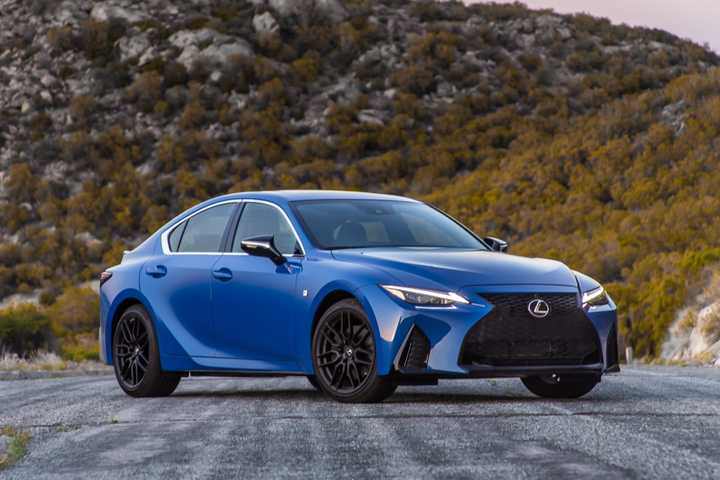
In a world where luxury sedans seem to be shedding cylinders faster than they gain massive touchscreens, the sports sedan segment has split into two distinct camps. One side wants efficiency, turbo torque, and tech-forward interiors. The other clings proudly to the sound and soul of a proper performance engine. Few comparisons illustrate this divide as sharply as the Lexus IS 500 versus the BMW M340i.
Both cars promise real performance. Both wear premium badges. Both aim at drivers who want something more interesting than the wall of crossovers parked in every suburban driveway. But the way these two approach the same mission couldn’t be more different. One is an old-school V8, the kind of car that feels like it dodged several federal memos. The other is modern efficiency done with Bavarian competence — an inline-six bolstered by mild-hybrid tech and wrapped in a cabin filled with smart screens and slick interfaces.

10 Performance Sedans That Outclass Sports Cars
This list celebrates ten extraordinary sedans that challenge the notion that conventional sports cars are the ultimate driving machines.
Performance And Powertrain
Engine Specs And Output

If this comparison were judged on engine character alone, the Lexus IS 500 would walk away before the BMW even found its start button. Lexus still builds its naturally aspirated 5.0-liter V8, a rare survivor in 2025. It makes 472 horsepower and 395 pound-feet of torque, but the raw numbers aren’t the point. The V8 revs with a rising, mechanical urgency you just don’t get from today’s torque-rich turbo engines. It’s one of the last small luxury sedans that still sounds like a performance machine instead of a household appliance.

The BMW M340i counters with a very different philosophy. Its 3.0-liter turbocharged inline-six produces 382 horsepower and 369 pound-feet of torque, but with the help of a 48-volt mild-hybrid system, the car fills in low-end torque seamlessly. The result is a wave of thrust that arrives early, stays consistent, and makes the M340i feel quicker than the numbers imply. There’s less drama here and more efficiency — but also plenty of speed.
Transmission And Drivetrain Options

- Base Trim Engine
-
2L I-4 ICE
- Base Trim Transmission
-
8-speed automatic
- Base Trim Drivetrain
-
Rear-Wheel Drive
- Base Trim Horsepower
-
241 HP @5200 RPM
- Base Trim Torque
-
258 lb.-ft. @ 1650 RPM
- Base Trim Fuel Economy (city/highway/combined)
-
21/31/25 MPG
- Base Trim Battery Type
-
Lead acid battery
- Make
-
Lexus
- Model
-
IS
Both sedans pair their engines with an eight-speed automatic, but they behave differently. The IS 500’s transmission feels tuned for the V8’s personality. It’s smooth, deliberate, and happier when you let the engine sing through the mid-to-upper revs. It’s not slow to respond, but it’s not chasing the dual-clutch sensation either.

- Model
-
3 Series
- Trim Tested
-
M340i
- Engine
-
3.0-Liter Turbocharged Gas DOHC Inline-Six
- Transmission
-
8-Speed Automatic
BMW’s unit is sharper and more willing to snap off shifts when the driver calls for it. The M340i’s torque curve allows the gearbox to surf the power band effortlessly. Add the option of xDrive all-wheel drive, and the BMW gives drivers in snowy climates a very real advantage. The Lexus is rear-wheel-drive only, which means it wins on purity but loses a few points on all-weather practicality.
Acceleration And Driving Dynamics

On paper, the BMW M340i is quicker to 60 mph thanks to its turbo punch and AWD availability. But the IS 500 fights back with linearity and sound — two things drivers feel more than they see on stopwatch readouts.
Where the M340i really shines is in precision. Its steering is sharper, its body control is tighter, and its chassis feels like it’s been groomed by decades of German sports-sedan refinement. It doesn’t shout about its performance; it just does the job with surgical neatness.

The IS 500 feels more alive. There’s a sense of theater baked into every input. The steering is weightier, the body rolls a little more, and the whole experience feels less filtered. It’s not as objectively capable on a mountain road, but it’s more emotionally rewarding when you find a rhythm.
Ride Comfort And Daily Usability
Cabin Comfort And Seating

The Lexus wins this section easily. Its seats are thick, supportive, and built for long-haul comfort. Lexus still understands how to make an interior feel inviting without drowning passengers in hard angles or over-styled seating surfaces. The IS 500’s front seats, in particular, strike a sweet balance between sporty bolstering and luxury cushioning.
The BMW M340i’s interior is polished but more businesslike. The seats are firmer, narrower, and shaped for drivers who spend more time cornering than cruising. They’re excellent for spirited driving but can feel stiff on longer trips.
Suspension Tuning And Everyday Ride Quality
BMW’s adaptive suspension is a highlight of the M340i. In Comfort mode, it smooths out all but the worst imperfections. In Sport, it tightens up enough to give you that classic BMW tautness. It’s an impressive dual-mode setup.
The Lexus IS 500, meanwhile, rides on the stiffer side — but not punishingly so. Lexus tuned this car to handle the V8’s weight and character, and you feel that every time you hit a bump. It’s composed, but it also reminds you that you’re driving something built with performance in mind.
Practicality And Noise Levels
Noise insulation in the IS 500 is excellent, though the V8 can roar when encouraged. The M340i is quieter overall, especially at highway speeds. Both cars have usable rear seats for adults on shorter trips, but neither qualifies as family-first. The BMW’s cargo space is slightly more generous thanks to a deeper trunk design.
Interior Design And Technology
Infotainment Systems

The BMW M340i wins this category almost by default. Its latest iDrive system is quick, intuitive, and loaded with functionality. Even the voice assistant is genuinely useful, which is saying something in a world where most in-car AI feels like an overconfident intern.
Lexus has improved its infotainment drastically, ditching the old touchpad interface for a far more responsive touchscreen. But while the system is now competent, it still can’t match BMW’s fluidity or deep feature set.
Driver Assistance And Safety Tech
Both sedans come with a strong suite of driver aids. Lexus Safety System+ is standard across the lineup and includes adaptive cruise control, lane-keeping assist, and more. BMW’s equivalent system is equally robust but offers a wider range of optional upgrades, including more advanced highway-assist features.
Cabin Aesthetics And Build Quality

Lexus leans into craftsmanship. Materials are soft, switchgear feels satisfying, and the overall cabin has an inviting warmth. The analog clock remains a nice touch in a digital era.
BMW goes for modern minimalism. Clean lines, metallic accents, and large displays dominate the space. It’s sophisticated but a bit cold compared to the Lexus.
Fuel Economy And Ownership Costs
Fuel Efficiency

The BMW M340i is significantly more fuel-efficient thanks to its turbo-six and mild-hybrid system. Drivers can see 26–30 mpg depending on configuration. The IS 500, with its burly V8, posts much lower fuel economy, and owners will feel that at the pump.
Maintenance And Reliability
Let’s not play around; this is a landslide victory for Lexus. Long-term reliability is one of its strongest selling points, and the IS 500 should be no exception. BMW maintenance costs are higher, and while modern BMWs are more reliable than their stereotypes suggest, they still can’t touch Lexus for long-term durability.

The American Car That’s Lexus Cool Without The Price Tag
This American sedan gives you all the luxury and sporty credentials you’d expect from a Lexus but without the heavy price tag.
Depreciation And Long-Term Value

V8 sedans are becoming endangered, which may help the IS 500 hold its value better than expected. The BMW typically depreciates faster, especially with high-option builds.
Price And Trim Breakdown
Base Pricing
The Lexus IS 500 and M340i basically start at the same price point–Lexus’ $59,520 to BMW’s $60,200. But when you look at price-to-cylinder count, the Lexus still feels like a bargain. The BMW M340i competes with the Lexus on base price but gets considerably more expensive with options — and BMW buyers usually tick boxes.
Options And Packages
BMW’s catalog is long, tempting, and pricey. You can easily push the M340i into entry-level M3 territory with enough options and performance packages. Lexus keeps options simple. What you see is mostly what you get, and the fully loaded IS 500 won’t drift as far from its starting price.
Verdict: Which Luxury Sports Sedan Wins?
Who Should Buy The Lexus IS 500

- Drivers who want a drama-free, reliable, sensible sedan that’ll also go like snot.
- Drivers who want sound — real sound.
- Drivers who want a sedan that blends in
The IS 500 is for the enthusiast who wants the full sensory experience, who values reliability, and who appreciates a car with a distinct personality without making much of a fuss about it.
Who Should Buy The BMW M340i

- Drivers who want a modern sports sedan with few compromises.
- Drivers who want speed even in the parking lot.
- Drivers who prioritize tech and flash.
The M340i is a rational choice — but still fun enough to make the rational choice feel rewarding.
TopSpeed’s Take
As with many of our car comparisons, there’s no wrong answer here. The winner depends on what you value. The BMW M340i is the sharper tool, the quicker car, the more advanced machine.
The Lexus IS 500 is the event — the kind of car people will talk about long after the segment has shifted to turbocharged hybrids. If your head makes the decision, the Lexus IS 500 wins. If your heart makes the call, the BMW M340i takes it.