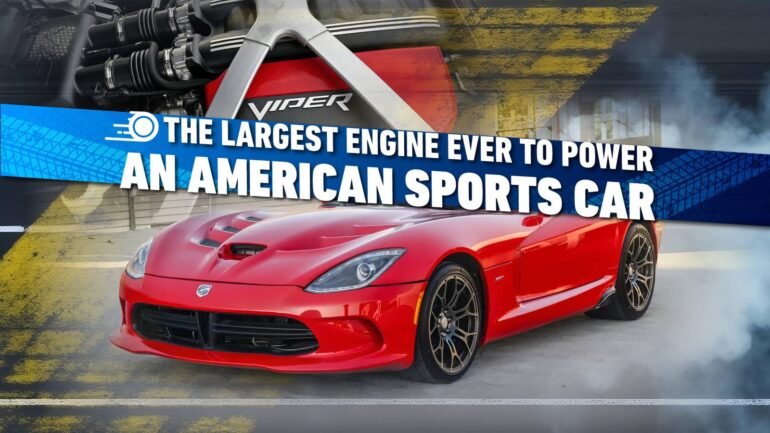
A lot of our favorite American sports cars are not subtle when it comes to the engine they utilize. Take the Camaro ZL1. It boasts a 6.2-liter supercharged V8; the Dodge Challenger reps an exceptionally powerful 6.2-liter HO HEMI V8, and the Hennessey Venom F5 totes a 1,817-horsepower bi-turbocharged ‘Fury’ V8. For some American brands, in the age of turbo-fours and smaller displacement mills, they still hold onto the adage ‘there’s no replacement for displacement’.

- Base Trim Engine
-
8.4L V10 Gas
- Base Trim Transmission
-
6-Speed Manual
- Base Trim Drivetrain
-
Rear-Wheel Drive
- Base Trim Horsepower
-
645 hp
- Base Trim Torque
-
600 lb-ft @ 5000 rpm
- Fuel Economy
-
12/19/14 mpg
- Make
-
Dodge
- Model
-
Viper
- Segment
-
Sports Car
We respect them highly for it. However, these are not the biggest engines to ever sit under the hood of an American sports car. That title goes to the Dodge Viper, our very own fire-breathing beast that, for certain model years, boasts a gargantuan V10. It may not be the most powerful V-engine ever created, but we loved what Dodge did here.
The 2008–2017 Dodge Viper Boasts The Biggest: An 8.4-Liter V10

During the latter part of the 2000s, and certainly into the 2010s, most automakers were starting to utilize smaller, turbocharged engines under the hood of their sports cars to give us the best of both worlds: relative efficiency and high power. But not Dodge. They decided to honor big displacement brutally by upping the size of the previous generation’s V10s.
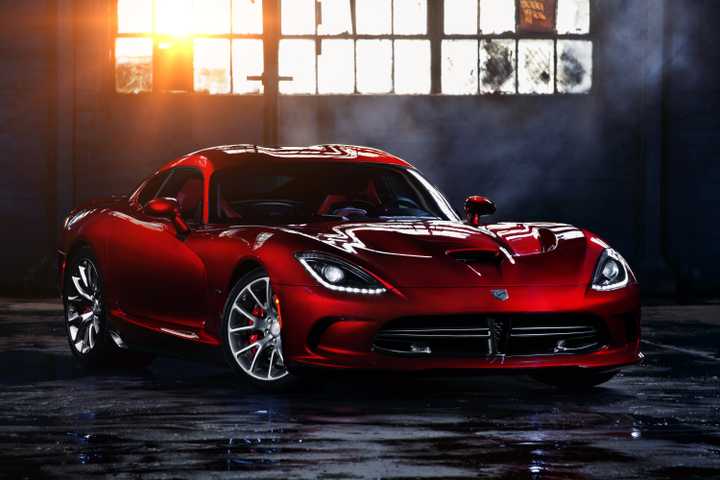
Under the hood of the 2008–2017 Dodge Viper, as part of the fourth (2008–2010) and fifth and final generation (2013–2017) of one of the best American sports cars to ever rip up the road, is a massive 8.4-liter V10.
The 8.4-Liter Beasts Beneath The Hood

When the Dodge Viper was initially released in 1992, it came equipped with an 8.0-liter V10 good for 400 horsepower; this was upped to 8.3 liters in 2003 for the Viper SRT, and for the last two generations, Dodge wedged in the 8.4-liter V10, making it the biggest engine ever fitted to an American sports car.
The Viper’s V10 began as an extension of Chrysler’s small-block thinking. Their team essentially added two cylinders to a Magnum/LA V8 and utilized aluminum castings developed with Lamborghini (which was owned by Chrysler at the time), and launched an 8.0-liter pushrod V10. Through the ’90s and early 2000s, the mill retained its 90-degree V10 layout and aluminum build, but was being reworked slightly to adhere to some emissions rules.
|
Spec |
1992–1996 Dodge Viper |
2002–2003 Dodge Viper |
2003–2008 Dodge Viper |
|
Engine |
8.0-Liter V10 |
8.0-Liter V10 |
8.3-Liter V10 |
|
Maximum Horsepower |
400 Horsepower |
450 Horsepower |
510 Horsepower |
|
Maximum Torque |
450 LB-FT |
490 LB-FT |
535 LB-FT |
It was the 2003 ZB update that nudged the displacement to 8.3 liters and brought in revised cylinder heads and better breathing. The 2008 model kicked off the biggest displacement engines with revised bore and valve sizing, and a more mature suite of tech to complement the bigger displacement. The final generations represent the evolutionary apex of LA-derived V10 Viper engines, and while still using the same architecture as the original ’92 Viper’s V10, Dodge gave the legendary line a heck of a send-off.
2008–2017 Dodge Viper Specifications

While the displacement was bumped up to 8.4 liters for the final two generations of the Dodge Viper, it is not the case that one engine fits all for all final model years and models. Factory horsepower ratings are the highest, with a range from 600 to 645 horsepower, and torque outputs are a lot healthier than in any other generation.
|
Spec |
2008–2010 Dodge Viper |
2013–2017 Dodge Viper |
|
Engine |
8.4-Liter NA V10 |
8.4-Liter NA V10 |
|
Horsepower |
600 Horsepower @ 6,100 RPM |
645 Horsepower @ 6,200 RPM |
|
Torque |
560 LB-FT @ 5,000 RPM |
600 LB-FT @ 5,000 RPM |
Regardless of what iteration of the 8.4-liter V10 you are playing with, 0–60 mph times and top speeds are ludicrous. The 2008–2010 Viper can get you from rest to 60 in roughly 3.7 seconds and tops out at about 200 mph, while the 2013–2017 models are even quicker, with 0–60 mph times of 3.5 seconds and top speeds of 206 mph.
What Makes The Viper’s V10 So Wild?

Horsepower is very respectable for the final iterations, displacement is massive, and it boasts the best engine configuration: a V. But that is not where the prowess of the Viper’s mill ends. It is more than the sum of its parts and size.
Arguably, the V10 utilized is beautifully simple. It is a 90-degree cam-in-block OHV V10 built like a bespoke performance motor with a forged-steel crank, forged pistons, CNC ported cylinder heads, cast-iron (slip-fit) liners, and deck-plate honing to keep the bore in line under heavy loads. What Dodge did here was choose correctly to make sure that the displacement of the mill didn’t feel flimsy and could actually make the most of the easy breathing nature and high-revving specs (maximum rpm is around 6,200 rpm).

However, what really makes the latter years’ 8.4-liter V10s stand out is the hardware they are paired with. The Viper’s 8.4-liter V10 benefits from variable valve phasing (cam-in-cam arrangement), twin electronic throttle bodies, and a lightweight three-piece composite intake with long runners to boost low-end grunt. Plus, sodium-filled exhaust valves and hardy valve springs have been added to give you higher rev stability.
Old-School Muscle Meets Modern Engineering

The 8.4-liter V10 under the Viper’s hood may just sound like a massive lump of metal, but in fact, it has been very carefully designed and paired with a finely-tuned ECU and cam/profile to ensure that what may seem like an old-school block can keep up with the more modern powertrains that were taking the market by storm in the late 2010s. That is why we love it, though; it is old-school and new-school tech in one impressive parcel.
Pushrod architecture for compact height and huge torque meets modern metallurgy and electronics. Purists among us get the mechanical prowess of yesteryear in the shape of big displacement, two valve heads, raw exhaust notes free from any turbo influence, and a broad torque band that gives immediate feedback. Alongside this, the use of modern materials (aluminum alloys and forged materials), computer-controlled ignition and fueling, and advanced intake and exhaust packages ensured it fitted with the emission controls of the day.
The Balancing Act That Dodge Nailed

Outside the immense sprinting capability and top speed, Dodge’s real win with the Viper’s V10 is in relative balance. They kept the feel of the engine primitive enough to create a thrill when driving and please the purists, while also keeping fairly up-to-date with the tech of the time, for it to work well on the road. What you get is an engine that feels like old-school muscle, courtesy of low-end shove at half-throttle, that responds with modern precision when you want it to.
The engine was refined and upgraded with new cams, forged aluminum pistons, aluminum cylinder heads, and a revised exhaust, now producing 640 horsepower. It finally received electronic stability control and traction control. Now on par with the best Euro supercars, the Viper’s top speed was a staggering 206 mph. Dodge continued to refine the Viper’s engine, improving its fuel economy and raising its power by another five horsepower in 2015.
– Review of Dodge Viper (Fifth Generation) by Magdan Daniel Cvitesic – Hot Cars
The Viper’s mill keeps the 103 x 100.6 mm geometry and huge displacement for muscle-car-esque grunt, then has had everything around it fine-tuned. Lighter rotating assemblies, freer-flowing exhaust plumbing, and recalibrated cam timing are utilized for a broad torque band, and even the paired Tremec TR-6060 transmission’s short gearing was chosen to keep the big V10 feeling hefty in the mid-range. The result is an engine that feels equally comfortable idling down a street as it does blasting to the redline on a track day, making it a rare breed of engine that blends modern precision and muscle car guts.
The Legacy Of The Dodge Viper And Its Hefty Heart

There is no doubt that all model years of the Dodge Viper are iconic; they are analog (to a large extent), they are fun to drive, they boast a naturally aspirated mill, and they are loud. It is arguably one of the most American sports cars ever created. Of course, the outrageous V10 at the heart of things is what a lot of us love about it, but there is more to the Viper; it can actually perform. It still holds the record for the largest and most powerful naturally aspirated V10 to ever be equipped in a factory-built sports car, and, by the way, things are looking in the modern market, we don’t see that changing anytime soon.
Up until very recently, the 2017 Dodge Viper was also the fastest manual production car around the Nürburgring, with a lap time of 7:01.30, only to be beaten this year by the 2025 Porsche 911 GT3, with a time of 6:56.294. We can see why it is such a loved American model; Dodge didn’t try and reinvent the V10 with the last two generations of the Viper, but instead refined it and made it a whole lot better.
The Standout Models Of The 2008–2017 Dodge Viper

Outside the engine, Dodge didn’t neglect the rest of the build, which is also why it has always stuck in our top-10 sports cars lists. The 2008–2010 ZB II generation was originally available as the SRT-10 and the more hardcore ACR (American Club Racer). Both boast the same engine, but the ACR comes equipped with adjustable coil-overs, carbon fiber aero pieces, and a massive rear wing that is capable of generating over 1,000 pounds of downforce at speed. This helped the ACR claim a 7:12 Nürburgring lap time, which, again, at the time, was a record lap time.
From 2013 onward, the Viper was at its most sophisticated and complete as the VX generation. However, the raw, analog feel of the V10 and purist setup was never lost; exactly why, despite the sports car market moving toward ‘newer’ tech, the Viper has remained a legend. The engine was placed 50 mm lower in the bay thanks to a redesigned spaceframe built from 50 percent aluminum and magnesium, while stiffness was improved by nearly 50 percent compared to the ZB platform.

The 2013 and 2014 models are available in two trims: the base and the more-refined GTS. Both come equipped with the Tremec TR-6060 six-speed manual box and a rear-mounted limited-slip diff, but the GTS also gets Bilstein DampTronic suspension, better soundproofing, and a relatively luxe cabin lined with leather. These early MYs of the VX-gen Vipers also replaced the side-exit exhausts with a rear system for better cabin cooling and flow, while weight was shaved off with the use of a carbon fiber hood, roof, and decklid.
In 2015, Dodge expanded the lineup with the TA 2.0 (Time Attack), a track-focused model that boasts Brembo brakes, carbon fiber splitters, Bilstein racing dampers, and unique orange detailing. It was built as a true track weapon made for the road, and with its gnarly configurations, it allows for 1.03 g of lateral grip.

Then there is the crowning moment for the Dodge Viper: the 2016–2017 Dodge Viper ACR. This beast is equipped with the Extreme Aero Package, which includes a huge wing. In an unbelievable feat of engineering, it can generate nearly a ton of downforce at 177 mph, making it one of the fastest cornering production cars ever created. Its carbon-ceramic Brembo brakes, adjustable Bilstein coil-overs, and bare-bones cockpit made it a race car that just so happened to also wear plates.
It remains the pinnacle of latter-year Vipers, and is one of the most capable, pure, and intimidating American sports cars of its time. It really was a fitting send-off for the Viper’s 8.4-liter V10.
What A 2008–2017 Dodge Viper Costs Today

For the V10 under the hood alone, it will make a lot of people want to buy one, but with everything else thrown in, it really is an iconic American sports car that demands a lot of respect. It has exotic looks, it performs well, and it is a standalone breed on the modern market. However, prices can be seen as very reasonable considering its crib sheet.
The fourth-gen Viper currently has used prices ranging from $78,240 to $112,340. The 2009 MY will cost you the lowest amount; the 2010 MY has an average used price of $95,500, and the 2010 MY has the highest average used price. These are averages, but according to Classic.com, the most expensive fourth-gen Viper went under the hammer for $132,000. This was an untampered-with 2009 SRT-10 model with 83,000 miles on the clock.
The fifth and final generation of the Dodge Viper is slightly different. It is more expensive, with an average auction price of $180,338. Each model year, though, is currently going across the block at different prices, with 2013–2017 Dodge Viper average auction prices as follows:
- 2013 Dodge Viper – $129,956
- 2014 Dodge Vipe- $136,491
- 2015 Dodge Viper – $174,250
- 2016 Dodge Viper – $213,799.
- 2017 Dodge Viper – $253,945
While it is no doubt a lot of money, we think the V10-equipped Dodge Viper models offer a lot of bang for your buck, especially up against models like the slightly more powerful 661-horsepower bi-turbocharged V8-equipped 2017 Ferrari 488 Spider, which is currently commanding an average auction price of just $235,000.
Other American Sports Cars’ Engines Came Close, But None Beat The Viper For Displacement
The Viper’s engine kicks the V10-equipped European out of the water at the same time as outsizing its American sports car counterparts by some way. Its main competitors, such as the Corvette, only muster a maximum of 6.2 liters of displacement; the Mustang GTD only gets a 5.2-liter V8 (but with truly devastating results), and even some of the old-school production models come in with smaller engines under the hood.
|
Spec |
1970 Chevrolet Chevelle SS |
1970 Buick GSX Stage 1 |
1968 Lincoln Continental Mark III |
2002 GMC Sierra 2500 HD |
1970 Cadillac Eldorado |
|
Engine |
7.4-Liter V8 |
7.5-Liter V8 |
7.53-Liter V8 |
8.1-Liter V8 |
8.2-Liter V8 |
|
Horsepower |
450 Horsepower |
360 Horsepower |
365 Horsepower |
320 Horsepower |
400 Horsepower |
|
Torque |
500 LB-FT |
510 LB-FT |
500 LB-FT |
455 LB-FT |
550 LB-FT |
The final two generations of the Dodge Viper boast the biggest engine ever fitted to an American sports car, and while its V10 is not the most powerful V-engine ever created, it is the most powerful V10 ever created for a road-going model. The main thing we love about it, though, aside from its size, is that it is an old-school rig that can be used as a modern track and road demon.
Sources: Kelley Blue Book, Classic.com, and J.D. Power.