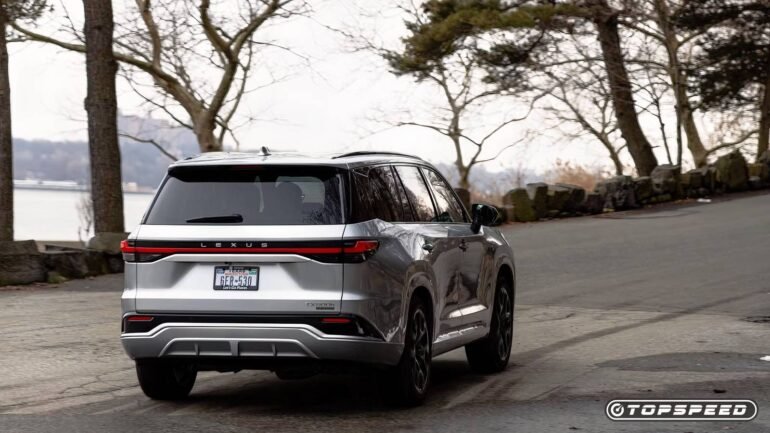

Lexus has always been a dominant force in the American luxury car market, as it constantly wins favor for offering impressive quality and reliability standards without compromising on overall comfort and presence. Traditionally, the Lexus RX and NX have been the brand’s most popular models, as they target the much more popular midsize segments. As of 2025, however, the Lexus TX model has quickly been rising in the ranks as a more popular option, which is interesting for the moniker that has always been a low-volume seller.
The premium three-row SUV benefits from the TNGA platform, affording prospective owners access to the new generation of ICE, HEV, and PHEV drivetrains. It’s one of the newer inclusions in the Lexus catalog, with the moniker only being born in 2023, as an unofficial replacement for the RX L. Due to this unfamiliarity, the TX hasn’t been performing as well, but that seems to be changing as 2026 draws closer. It’s evident that more people are starting to notice this as a viable flagship SUV option from the popular Japanese brand.
The Lexus TX Sales Performance Is Improving

Lexus has been enjoying considerable success with the TX for the entirety of 2025, with November being a highlight month. Toyota’s sales report indicates that it has sold 5,787 copies of the three-row SUV in November alone, reflecting a 75.5 percent sales increase compared to the same period last year. This year so far, it confirms a 50,433 individual unit sales figure, reflecting a 101.7-percent year-on-year sales increase. The TX remains a poorer-performing model across its entire catalog, but it enjoys the biggest sales increase in its range, and by a massive margin. In fact, it was the only model to enjoy an increase in sales for the year, and one of very few across the entire Toyota Group in the U.S.

Even if we isolate the hybrids, we see that the TX’s popularity is growing more across the board. The Japanese brand confirms to have sold 1,012 copies in December, indicating an 89 percent increase year-on-year, and bringing its tally for the year up to 9,412 copies, which is 126.9 percent better than last year. It only moved 92 copies of the 550h+, but this still reflects a 122.5 percent year-on-year increase. This year so far, it has sold 96 copies of the PHEV, which is 102.6 percent better than last year.
High But Competitive Pricing
Lexus offers the TX in four configurations, including the ICE, hybrid, PHEV, and F-Sport performance hybrid. In total, there are 10 possible variations for you to choose from, but most drivetrain configurations are available with the base, Premium, Luxury, and F-Sport. The base configuration starts pricing off at $57,090 for the 350, with key features including NuLuxe interior upholstery, front heated seats, and an electronic rear hatch with a kick sensor. Upgrading to the Premium will cost you $59,890, adding a panoramic glass roof, heated and ventilated front seats, and a power-folding third-row bench. Upgrading to the all-wheel drive system costs $1,600.

The Luxury increases the price to $62,240, and adds semi-aniline leather upholstery, heating for the second row of seats, and thematic ambient interior lighting. The F Sport Handling costs $66,360, and is only available with the all-wheel drive system, adding dynamic rear steering and active sound control. The 500h F Sport is only available in Premium and Luxury trims, priced at $70,610 and $73,760, respectively. The PHEV is only available in Luxury guise for $80,960.

2025 Lexus TX 500h F-Sport First Drive: Why Didn’t They Think Of This Before?
Lexus finally enters the full-size luxury crossover SUV space after dominating the midsize niche for nearly 30 years.
Impressive Reception From Owners And Publications

J.D. Power issues the 2026 Lexus TX with an 80/100 consumer-verified overall score, including 80/100 for quality and reliability, 75/100 for the driving experience, 79/100 for resale, and 85/100 for the dealership experience. iSeeCars doesn’t issue a full review, but it does issue the SUV with a full review, but it does award it with an 8.4/10 retained value and 8.0/10 safety rating.
As the purveyor of the best-selling SUV and luxury SUV in America of all time, the Lexus TX makes you wonder why the Japanese automaker didn’t make it sooner. Large, three-row crossover SUVs are undoubtedly one of the most popular and in-demand vehicles in all the land, and it’s a concept that’s been around for over a decade at this point.
– Chris Chin for TopSpeed
In terms of consumer reviews, the Lexus TX doesn’t benefit from the best ratings on Edmunds, with it currently holding a 3.9/5 rating. Owners indicate that the TX excels at translating a good ride quality, a spacious interior, and good engine performance, but it does lose some points for not offering the best value, showing some quality concerns, and poor braking performance.

The 2026 Lexus TX faces stiff competition from rivals like Volvo XC90, BMW X7, and Audi Q7, and indirectly the Acura MDX. Compared with the XC90, the TX delivers more cargo space and a larger third row, while the XC90 has more refined styling, optional plug-in hybrid power, and standard AWD. Against the X7, the TX undercuts it on price and remains more practical, but the X7 offers a more luxurious cabin and stronger road presence. The Q7 makes up for less cargo and room by being more agile and offering sharper handling than the TX.
Reasonable Value Retention Rates

On the depreciation front, iSeeCars indicates that you can expect the TX 350 to lose $22,925 or 41.6 percent of its value after five years and 60,000 miles, which is a lot better than what its main rivals lose during this period. CarEdge indicates that the Lexus TX is likely to lose $22,386 of its value after five years, while also costing you $2,660 in maintenance and repairs, and $8,555 in fuel, bringing its total ownership cost up to $56,661.

Lexus TX Price, Configurations, And What You Get For The Money
The 2024 Lexus TX comes at several price points across many trims. Could this three-row midsize Lexus SUV be right for you? See what it offers.
A Versatile Range Of Drivetrains

There are four unique drivetrain configurations available for the Lexus TX range. The base-level 350 features Toyota‘s turbocharged 2.4-liter four-cylinder engine and an eight-speed automatic transmission driving your choice of the front or all four wheels with 275 horsepower and 371 pound-feet of torque, resulting in an eight-second zero to 60 MPH acceleration time for the front-wheel drive and 7.8 seconds for the all-wheel drive system. Lexus limits the top speed to 112 MPH and towing to 5,000 pounds.

The 500h keeps the same engine, but integrates an electric motor alongside the transmission, increasing the combined output to 366 horsepower and 406 pound-feet exclusively to all four wheels. This gets you from zero to 60 MPH in 6.1 seconds, with no changes to the top speed or towing capacity.

The 550h+ adopts Toyota’s twin-turbocharged 3.5-liter V-6 with a plug-in hybrid system, producing a combined 406 horsepower, which is enough to get it from zero to 60 MPH in 5.9 seconds. Lexus clarifies that this model is not suited for towing.
Competitive Fuel Consumption Estimates

On the fuel efficiency front, the ICE 350 returns an EPA-estimated 21/27/23 MPG on the city/highway/combined cycle, while covering 409 miles on a single tank of gas, measuring 17.8 gallons. Expect to spend $5,000 more on fuel over five years compared to the average new vehicle in the U.S., spend $2,600 on gas every year, and $4.33 to drive 25 miles. A full tank of gas is going to set you back by about $71. The all-wheel drive model essentially returns the same consumption estimates, except for its 20 MPG result on the city cycle and 26 MPG figure on the highway.

Opting for the hybrid means that you get to enjoy a more appealing 27/28/27 MPG consumption estimate and a 462-mile range claim. Expect to spend $3,000 more on fuel over five years, while spending $2,200 a year and $3.69 to drive 25 miles. The hybrid’s tank only measures 17.1 gallons, which will cost you about $68 to fill.

The 550h+ PHEV consumes 76 MPGe when using electric and gas, 45 kWh/100 miles when running on electricity, and 29 MPG when only using the ICE. The gasoline system covers 450 miles, while the electric system will only do 33 miles per charge. With this model, you can expect to save $1,000 on fuel costs over five years, while spending $1,400 on fuel and electricity every year. A single charge of the battery will cost you $1.69, while the ICE will cost you $3.43 to drive 25 miles. The PHEV only needs a 14.5-gallon tank thanks to its larger battery pack, which will cost $58 to fuel.