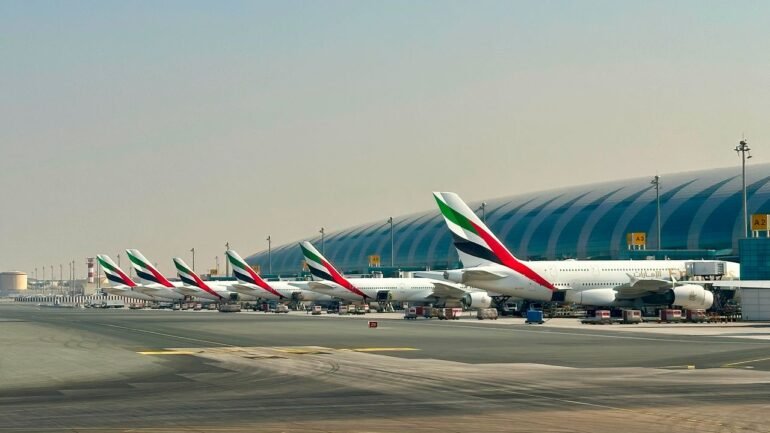
The UAE is planning hundreds of repatriation flights in the coming weeks to help stranded travelers return to their home countries, according to government officials.
This comes after days of missile and drone exchanges triggered widespread closures across Gulf airspace, grounding thousands of flights and leaving tens of thousands of passengers in limbo.
Speaking at a Tuesday media briefing, Dr. Saif Al Daheri of the National Emergency Crisis and Disasters Management Authority said the UAE government is working with airlines on a phased approach that will see up to 300 planes taking off “soon.”
Dubai resumed limited airport operations on March 2, with a small number of flights operating from Dubai International Airport (DXB) and Al Maktoum International Airport (DWC).
UAE flight operations have begun to resume in stages, according to H.E. Abdulla bin Touq Al Marri, the country’s Minister of Economy and Tourism. Per the media briefing, a total of 60 flights have transported nearly 17,500 passengers from the UAE since Sunday, March 1. The next phase will operate more than 80 scheduled flights per day with capacity for 27,000 passengers, he said.
The UAE is working with neighboring Gulf Cooperation Council (GCC) countries and the International Civil Aviation Organization to develop emergency air corridors where planes can safely fly over the region, H.E. Al Marri added.
In parallel, the General Civil Aviation Authority announced the start of “exceptional” flight operations at UAE airports to enable stranded passengers to depart, urging travelers not to proceed to airports unless they have been contacted directly by their airline with confirmed flight details.
On Monday and Tuesday, a limited number of aircraft departed from Dubai and Abu Dhabi bound for destinations including London, Amsterdam, Moscow, and Riyadh.
The aviation restart comes amid one of the largest regional disruptions since the COVID pandemic, with aviation analytics firm Cirium estimating about 13,000 of roughly 32,000 flights scheduled into and out of the Middle East since Saturday have been cancelled.
H.E. Al Marri also said the UAE government has committed to supporting passengers stranded due to flight suspensions, including by covering accommodation and living expenses and ensuring necessary visa arrangements until travel plans are resolved.
This story was originally published on Condé Nast Traveller Middle East. This is a developing news story and will be updated with more information.