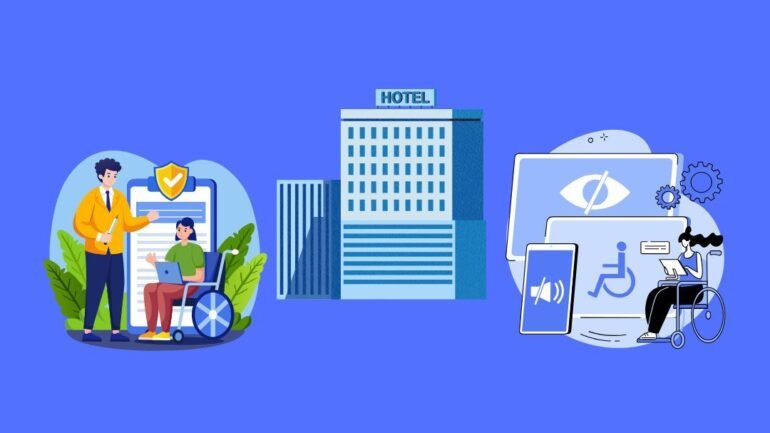
Hospitality professionals focused on hotel revenue optimization often chase new channels and promotions while a quieter leak persists at the front desk, on the phone, and online. Guest accessibility challenges can turn simple questions into friction, and friction turns into abandoned bookings, weaker reviews, and lost loyalty. When a property can’t confidently explain what’s accessible or offer clear disability service alternatives, disabled travelers and their companions move on quickly. Treating accessibility as service, not a checkbox, opens an untapped hospitality market.
Understanding Accessibility as a Revenue Driver
Inclusive service is not just a compliance task. It is an accessibility business case: make it easier for disabled guests and their companions to choose you, book faster, and feel confident about the stay. When half of the hotels still make accessible booking hard, clarity and better options become a competitive advantage.
It matters because accessibility shows up in the numbers you already watch: conversion, cancellations, review sentiment, and repeat business. AI can help teams answer accessibility questions consistently, document features clearly, and offer service alternatives that keep the guest moving toward “book now.”
Picture a call where a guest asks about shower access and hearing support. A scripted, AI-assisted response that confirms details and offers alternatives turns uncertainty into trust, and trust turns into bookings.
7 Low-Lift Upgrades Guests Notice Immediately
Small accessibility upgrades are some of the fastest “friction removers” you can buy, and they pay back in conversions, smoother operations, and better reviews. Use this menu to pick a few changes you can implement this month, then build momentum.
-
Run a 30-minute “friction walk” and fix the obvious: Walk one guest route end-to-end: parking → entrance → front desk → elevator → room → bathroom → breakfast. Capture 10 photo notes of tiny blockers such as heavy doors, unclear signage, a slippery mat, or a check-in counter that’s hard to hear across. Assign each item an owner and a “48-hour fix” or “30-day fix” label so improvements actually ship.
-
Upgrade the room, not the whole building, with a small accessible-feature kit: Start with a handful of high-impact items you can store at the front desk: a portable shower chair, a handheld showerhead, bed risers, a non-slip bath mat, and extra hangers at a reachable height. Add simple in-room tweaks like lever-style hardware where feasible and a clear path around the bed (move the chair, reduce clutter). Guests notice when the room feels usable without asking for special treatment.
-
Make communication easier with “service alternatives” (not exceptions): Offer multiple ways to do the same task: text-based requests, phone, and in-person; digital registration and paper; email folios and printed copies. Put these options on your pre-arrival message and a one-page “How to Reach Us” card in the room. The goal is fewer stalled requests and fewer “I tried calling but…” complaints.
-
Add assistive tech that reduces calls, not just adds gadgets: Start with TV captions set to “easy on,” a bedside lamp labeled clearly, and an in-room quick guide with large font and plain language. If you’re considering voice controls, focus on limited, high-frequency actions (lights, temperature, curtains) and train staff on privacy scripts and how to disable them on request. A real-world example shows the upside of this approach: guest satisfaction increased 23% after a major property rolled out voice-activated room controls.
-
Teach a simple accessibility service script in 15 minutes per shift: Train teams to ask one proactive question and offer two options: “Do you have any access needs for your stay?” and “Would you prefer text updates or a call?” Then practice respectful language (“accessible room” instead of “handicap room”) and what to do if a guest says the room setup isn’t working. This is a low-cost staff training program that improves confidence and reduces on-the-spot improvising.
-
Create a “rapid response” playbook for the top five access requests: List the most common needs, extra pillows for positioning, a refrigerator for medication, a visual doorbell/knock alternative, a shower stool, a room move, and define the steps, storage location, and promised response time. Put it in your shift handover notes and inside your service platform as saved replies. Consistency is the experience: guests remember fast, calm resolution more than the problem itself.
-
Make accessibility information searchable and bookable on your website: Add a dedicated “Accessibility & Room Features” page with photos, measurements where possible (door width, bed height), and plain-English descriptions of what’s in each accessible room. Mirror that same info in your listings and confirmations so guests don’t have to call to verify basics. Clear details reduce booking friction, the exact revenue lever you identified earlier.
Accessibility & Service: Common Questions Answered
Q: What are some cost-effective accessibility improvements hotels can implement to attract guests with disabilities?
A: Start with low-lift fixes that remove friction: clearer wayfinding, better lighting, non-slip surfaces, and portable equipment like shower chairs and bed risers. Standardize captions on remotes and offer text-based requests so guests can get help without barriers. Track impact using review keywords and repeat requests to prioritize what pays back fastest.
Q: How can hotels identify and overcome operational challenges when serving guests with disabilities?
A: Treat issues as process gaps, not one-off exceptions. A simple audit that checks whether ramps/elevators are functional and whether staff know escalation steps will surface the biggest blockers. Then assign owners, set response-time targets, and rehearse one respectful service script per role.
Q: In what ways can modern technology help hotels enhance accessibility and boost guest satisfaction?
A: Use tech to reduce effort for guests and staff: chat and SMS for requests, digital check-in alternatives, and knowledge bases with saved replies. Strong customer feedback analysis turns comments into recurring themes you can fix systematically. Keep it practical: automate updates, not empathy.
Q: Why is it crucial for hotels to address accessibility needs rather than risk losing potential revenue?
A: Accessibility influences booking confidence, length of stay, and reviews, which directly affects occupancy and rate. When guests cannot verify features or get timely assistance, they abandon the booking or never return. Improving access also reduces service recovery costs because fewer stays start with frustration.
Q: How can a person with disabilities create and leverage supportive networks to navigate and advocate for their needs when traveling and staying in hotels?
A: Encourage guests to share preferences early and in writing, then confirm back what will be provided and who is accountable. A supportive network can include travel companions, a trusted contact, and direct access to a manager who can resolve issues quickly. Check this out for a quick look at how support systems help people stay on track. Hotels can help by offering a single point of contact and a clear, repeatable way to request accommodations.
Accessibility Options Compared for Fast ROI
This table compares high-ROI accessibility and service upgrades through a practical lens, focusing on the impact on guest confidence, operational lift, and payback speed. Use it to decide what to pilot first, especially if you are evaluating AI-supported workflows that reduce staff load while improving consistency.
| Option | Benefit | Best For | Consideration |
| Accessibility info refresh in booking flow | Fewer pre-arrival questions; higher booking confidence | Properties with unclear feature descriptions | Needs ongoing updates after room changes |
| AI-assisted request intake (SMS or chat) | Faster routing; fewer missed accommodations | High call volume and lean front desks | Must offer a non-digital alternative |
| Micro-training plus role scripts | More consistent, respectful service delivery | Multi-shift teams and seasonal staff | Requires refreshers and manager coaching |
| Portable accessibility kit inventory | Solves frequent needs without renovation | Older buildings or limited capex | Storage, cleaning, and tracking are required |
| Web and digital accessibility cleanup | Better usability plus potential business upside | Hotels investing in digital conversion | Some studies cite $100 in benefits from accessibility spend; results vary |
If you need speed, start with request intake and scripts since they cut errors immediately. If you need scale, tackle digital clarity and accessibility so guests can self-verify and self-serve. Pick one row, assign an owner, and you will feel momentum fast.
Turn Accessibility Improvements Into Reliable Hotel Revenue Growth
It’s easy to keep accessibility on the “someday” list when budgets are tight and teams are stretched, but that’s exactly how demand slips past your front desk. The approach here is simple: treat disability-inclusive hospitality as a service and revenue practice, then prioritize changes that deliver fast ROI and better experiences. When you do, the accessibility improvement benefits show up in smoother operations, stronger reviews, and capturing untapped revenue from guests who were ready to book, just not with you. Accessibility isn’t a cost center; it’s a welcome that pays back. Choose one action step for hotels this week, assign an owner, and set a start date. That’s how motivating hospitality change becomes a more resilient, future-ready business.
Ready to Take the First Step with AI?
If you’d like to see how this works in practice, you can test drive the AIDURIX Compass, a practical way to experience how AI can shift your leadership focus from micromanaging to vision-setting. 👉 Explore the Compass here
Let’s Talk
👉 What signals would you most want an AI system to surface for your hotel, guest behavior, staff performance, revenue leaks, or something else?
👉 How are you educating hoteliers about the WHAT, HOW, and WHY of your tech?
Drop your insights in the comments, because the more we share, the faster our industry transforms. I’d love to hear where you see the biggest opportunity.
👉 Next Steps
Comment below: Which persona sounds most like your property?
The future of hotels isn’t about flashy gadgets; it’s about embedding intelligence into your very DNA. Dive below the surface and discover the hidden engine that will reinvent everything you thought you knew about hospitality.
See you beneath the waves!
And if you’re ready to take the first step, I invite you to join me for a complimentary 60-minute Hotel AI Consultation. Together, we’ll unlock what AI can do for your brand. Send me a DM on LinkedIn to learn more.
Ready to Transform Your Hotel? Discover how AI and innovative education can redefine hospitality. Let’s start the conversation!
Contact me today to discuss how we can leverage your hotel’s AI, social media, and creative content to revolutionize your hotel and create a truly unique and unforgettable guest experience.
This collaboration will allow us to:
-
Assess your specific needs and goals: We’ll work together to identify the key areas where AI can make the biggest impact on your business.
-
Develop customized AI agent personas: We’ll craft AI agents that embody your brand and resonate with your target audience.
-
Implement and integrate AI solutions: We’ll seamlessly integrate AI into your existing systems and workflows, ensuring a smooth transition and minimal disruption.
-
Provide ongoing support and optimization: We’ll continuously monitor and refine your AI agents to ensure they’re delivering exceptional results.
By partnering together, we can create a truly exceptional hospitality culture where AI and humans thrive together and provide a thrilling experience for everyone involved. Let’s shape the future of hospitality together.
Your Hotels AI Compass
Want the AI Compass 2026 Readiness Checklist with AIDURIX implementation insights? Watch the AI Compass Showcase and take the Free Transformation Readiness Engine check.
Let’s make hospitality human again, powered by intelligence, guided by empathy, and driven by imagination.
Over to you
The hotel industry is always changing, especially during a time of crisis. Make sure to future-proof your business and continue attracting new guests by investing in these solutions.