When you think of the Himalayas, India typically isn’t top of mind. The Indian Himalayas stretch from China to the border of Nepal, and those who know say the Kumaon region is the most majestic. Its star is Nanda Devi, once thought to be the world’s tallest mountain at 26,669 feet (until a survey identified Everest in 1841). Nanda Devi, which means “Bliss-Giving Goddess,” has a UNESCO-recognized national park, and yet this mountain and her sisters are unfamiliar outside of India. Don’t expect to see a human traffic jam here like you do on Everest. In fact, during my week-long hike, I never saw another foreign traveler; instead, I connected with locals as I passed from village to village and experienced my own bliss at Shakti ultra-luxury lodges. I felt like I had the Himalayas to myself.
My host, Jamshyd Sethna, is a chic 72-year-old from Mumbai with flowing silver locks and equally flowing opinions. Sethna went to boarding school in northern India and began trekking around the area on his school breaks, falling for the raw beauty of the region. As an adult, he would make note of everything he was missing on his treks, like luxurious beds and higher-end amenities. Sethna created India’s bespoke Banyan Tours in 1996, so he was familiar with the luxury travel market. Ten years later, he decided to venture north and opened Shakti Himalaya—a luxury walking company offering curated journeys—out of sheer love of the mountains. Sethna was convinced there were plenty of travelers out there like him and his friends, who would want to see a truly authentic and otherwise inaccessible side of India on foot—but then retire to a luxury guest room, a drink by the fire, and excellent food. His clientele tends to be in their forties up to their seventies, and 40 percent are women on solo treks.

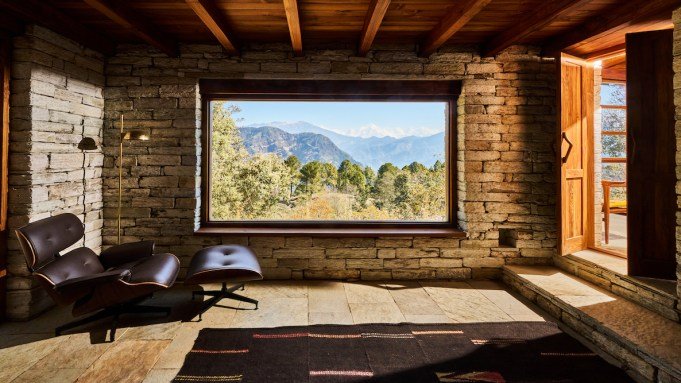
Shakti Prana lodges were built by hand, with stone carried up steep mountain passes.
Sethna has been personally involved in every aspect of the Shakti Himalaya experience from the start, focusing on sustainability at all turns. He scouted the locations for Shakti’s two newest properties over the last decade, settling on iconic mountaintops. Two new luxury lodges—Shakti Panchachuli, set against the border of the Panchachuli mountains, and Shakti Prana, in the shadow of Nanda Devi range—officially opened last month. Both are in keeping with Shakti’s focus on luxury, authenticity, high design and five-star service, but Prana, Shakti’s crown jewel, will be the first property open to multiple bookings at a time. (All of the four other Shakti properties in Kumaon are full buyout.)
Prana is remote: nearly five hours’ drive from Pantnagar Airport on hairpin mountain roads, and a steep mile walk (that takes nearly an hour) from the road to the property. On the journey up, I passed some of the mules that carried materials up and down the hill during construction. Because of its seclusion, Prana had to be built by hand. Each of the seven cottages has a floor-to-ceiling window with views of the jagged mountains, a wood-burning stove, a sitting room, and a stone bathroom. Meals are safari-style, with a cocktail hour around the central lodge’s stone fireplace before a multi-course meal prepared by Chef Yeshi, a former Tibetan monk.

A morning tea unlike any others.
Mornings began, as they do at every Shakti property along the village-to-village hike, with a gentle knock on the door, the quiet delivery of an elegant ceramic pot of ginger tea and cookies. A hike through the Himalayas could bring any number of surprises, but each of the Shakti properties I stayed in had a consistent level of comfort and an impressive private chef. Breakfast in the dining room was a series of fresh fruits like papaya and pomegranate, homemade yogurt, granola with nuts, local eggs, and a variety of Indian dishes. Then I would meet up with Pujan Rai, who’s been a Shakti guide for nearly 20 years and runs on his days off from walking. Each day was different and customizable, depending on how far I wanted to walk and what we saw along the way. The trails weren’t on a map; they were designed by Rai and a rotating local guide in each area we visited.
On the last day of the Hindu holy festival of Navaratri, I stepped outside my cozy, revamped traditional mountain house to celebratory buzz. My first stop on the day’s nine-mile walk was at a nearby home where a woman in red blessed my forehead with a colorful paste and grains of rice. I walked through terraced farms, the Diodar forest full of pines and blossoming rhododendrons, and on to Jageshwar Dham temple complex—one of the holiest Hindu sites with more than 100 ancient temples — where priests anointed visitors with ashes, rice, flowers, and powder. In between these points of interest were little moments of luxury, like fresh juice and a crisp cold towel on a cliff, and a mountaintop white-tablecloth picnic lunch catered by a private chef. Each night, we returned before sunset for a decadent and healthy multi-course meal.

Chef Yeshi prepares a healthy yet decadent meal.
As the days went on, my guides and I walked through more red rhododendron blossoms blanketing the ground, green pine forests, and past mountain stretches that glittered with gold pyrite. We found snow leopard paw prints and spotted pine martins and eagles. A local guide brought us to his home to meet his wife and daughter and try fresh buttermilk straight from one of their cows. We spotted endangered orchids growing wild on trees in a forest days later. We paused to watch the drama as a family of farmers chased a gang of bold monkeys away from their crops in a military-like operation. We passed animals grazing and were joined by curious dogs who wanted to pass the time. Village children far off in the distance yelled and waved hello. It felt mentally immersive but physically challenging. One day’s walk was only four miles, but the equivalent of 70 stories of elevation. This is the Himalayas, after all.
After days of trekking village-to-village, I arrived at Prana during an unseasonably hot haze on the brink of a thunderstorm. The stars of the region—those spectacularly tall mountain ranges—were hidden behind an atmospheric gray wall and a dry, oppressive heat for days.

Goat traffic jam.
On my second to last night, thunder echoed and bounced across the valley. Once the rain cleared the air, the bright white peaks of Nanda Devi glowed against a pink sky at sunrise. Eager to see these towering snow-capped peaks from as many angles as possible, I asked my guide to have breakfast early and start toward the Jhandi Dhar ridge walk. I walked up a ridge, then down into a valley before ascending back up, a natural rollercoaster with sweeping views on each side of the mountain spines. A herd of goats swarmed me on a steep peak, chomping any low-hanging tree branches and bushes in between bleats and a soundtrack of ringing collar bells. From there, more ups and downs along the ridgeline over Kanoli village, broken up by a local farmer asking if we’d like to share some chai. Nanda Devi was off in the distance, the crisp white outline of the peak blending in with the rest of the snow-capped range. At the 8,500-foot summit of my journey, I stopped to admire the views with fresh juice and homemade cookies.
The trip ended 49 miles, 436 floors, and 123,318 steps through the Himalayas later, on foot. On the final night of the trip at Shakti’s Panchachuli property, I watched the sun spread its final colors across the terraces and valleys below, while enjoying a drink on the stone terrace. I listened for the sounds of any far-off tigers and wondered if they could see the stone house’s lights twinkle on. I thought about the trip, remembering the feeling of smiling people pressing colorful paste onto my forehead for blessings, and the raining red rhododendron flowers in the forests, and discovering new-to-me foods. While some adventures involve scaling the world’s largest peaks and checking off bucket lists, others summon the feeling of exploration by connecting with the landscape in a slow and thoughtful way.