Back in 2015, high-income renters were still somewhat of an anomaly. A report by RentCafe found that the number of U.S. households earning over $150,000 a year but choosing to rent grew by 82 percent between 2015 and 2020. Even more surprising, the number of renters reporting annual incomes of $1 million or more hit a record 3,381 in 2020. By 2021, households making $150,000 or more were renting 3 million units nationwide, according to the U.S. Census Bureau, marking an 87 percent jump in just five years.
Cities like Austin, Nashville, Atlanta, and Phoenix saw some of the fastest growth, a trend supercharged by the pandemic as affluent movers sought flexibility and newer markets outside traditional coastal hubs. If these early statistics once seemed a curiosity, today they signal a broader shift in high-end real estate: from New York to Miami to Los Angeles, developers are responding with buildings designed to cater to tenants who prioritize lifestyle, turnkey living, and flexibility over the permanence of ownership.
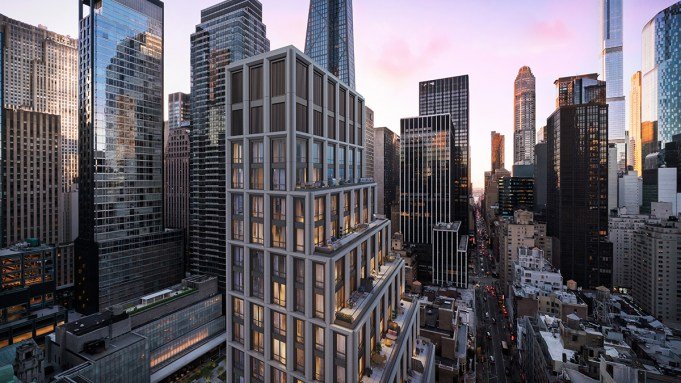
In Manhattan, 18W55, a Morris Adjmi-designed tower from Skyline Developers, illustrates the trend. The 97-unit building, with studios to three-bedroom penthouses, features finishes and layouts typically reserved for condominiums, 17 private terraces, and a penthouse commanding $35,000 per month. Residents enjoy over 10,000 square feet of amenities, including a two-story fitness center, private cinema, golf simulator, coworking suites, and social lounges. “Today’s renters seek flexibility without sacrificing design, service, or lifestyle—qualities typically reserved for condominiums,” says Orin Wilf, principal of Skyline Developers. “18W55 sets a new benchmark for elevated luxury rental living in Midtown.”
RELATED: Italian Visionary Piero Lissoni Designed the Interiors of These Miami Beach Condos

The interior of the homes at 18W55.
Streetsense
Over in Miami, the shift toward renting is about far more than convenience. Armando Codina, developer of Regency Parc in Coral Gables, has been anticipating this trend for years. “Condominiums have gotten very, very complicated,” he says. Insurance challenges after hurricanes, even California wildfires, have put enormous pressure on insurers. Add to that the fact that older buildings are facing soaring repair costs, and even newer developments now require careful vetting. “It’s a have-and-have-not market,” Codina explains: the haves are newer, reputable buildings; the have-nots are older properties struggling with insurance and structural issues.
At Regency Parc, opening in March 2026, Codina approached the problem differently, designing a 126-unit building with large, drama-free residences that feel like homes rather than apartments. Layouts range from 1,800 to 12,000 square feet, with open, flexible floor plans. “We designed every unit from the inside out,” he says. The amenities reflect that same philosophy: telemedicine and Zoom rooms, indoor dog parks, salons, a 15-foot theater, restaurants, private courtyards, and pools with cabanas. Art is integrated throughout, including a mural in progress and a sculpture by Lynda Benglis.
The building primarily attracts two groups: empty nesters looking to downsize and New Yorkers establishing residency while they determine where to buy or renovate locally. Royal Caribbean Group Chairman and former CEO Richard Fain, for example, recently listed his 10,840-square-foot Coral Gables mansion for $42 million and signed a long-term lease at Regency Parc. Codina himself is also moving in, a rare gesture from a developer, signaling confidence in the project and the lifestyle it offers. “The only thing worse than living in a condo is to live in one you developed—but not in this building,” he says.
RELATED: Private Aviation Access Is the Latest Must-Have Amenity in Ultra-Luxe Developments

The exterior of 700 Broadway in Santa Monica.
Related California
Los Angeles has seen a similar shift toward lifestyle-driven luxury rentals. Related California’s 700 Broadway in Santa Monica offers 196 residences with interiors by Marmol Radziner and nearly three-quarters of an acre of private parkland. Rooftop pools, co-working lounges, bowling alleys, screening rooms, an on-site grocery, and a 24/7 attended lobby rival a five-star hotel.
“At 700 Broadway, we’re seeing people who want to live in a premier building with condo-grade finishes, premium amenities, and the highest level of services,” says Gino A. Canori, president of Related California. He notes that Santa Monica was missing a rental product of this caliber, making demand especially strong among those who want to be close to the beach without sacrificing luxury.
Canori emphasizes that wellness, design, and convenience are integrated into every layer of the building: “At the heart of 700 Broadway is The Grove—a nearly three-quarter-acre private park, landscaped with mature olive trees and anchored by a fitness pavilion with an open-air terrace. A rooftop retreat offers panoramic ocean and mountain views with a 75-foot lap pool, hot tub, cold plunge, and two cedar barrel saunas. Today’s renter has many choices, so you have to deliver an exceptional experience.”

The building has ocean views, a private park, a rooftop pool, a bowling alley, and an Equinox gym.
Related California
Austin is also emerging as a hub for affluent renters, with towers like 6G at 600 Guadalupe and The Waterline. (The latter is set to be the city’s tallest building.) These developments, featuring expansive layouts and prime downtown access, cater to tenants who want the city’s energy without long-term ownership.
Across markets and price points, the story is consistent: wealthy households are choosing freedom, flexibility, and lifestyle over the permanence of ownership. Manhattan, Miami, and Los Angeles all demonstrate that renting has evolved from a practical compromise into a strategic, highly curated choice for America’s most affluent.
Authors
-

Abby Montanez