Did you know Honda holds the “world’s largest motorcycle manufacturer” title? And that it has done so for quite some time? Accolades like these don’t come easy, and if you look closely, you’ll realize much of this is because of its excellent commuter bikes. These don’t cost much, ensure comfortable ergonomics, and sip fuel really slowly. However, most of these commuters are specific to markets, so you’ll only find a few of these in the US.
After all, the North American moto market is quite tough to crack, since two-wheelers are a passionate purchase and the yearly sales numbers are some of the lowest in the world. As a result, we only had three shortlisted names for this story about Honda’s fuel-saving commuter bike. All three claim similar numbers, but one bike edges the other two. Oh, and we’ll stick to full-sized motorcycles, skipping mini motos here.
To give you the most up-to-date and accurate information possible, the data used to compile this article was sourced from authoritative sources, such as Honda Powersports.
The CB300R Is Honda’s Fuel-Saving Star In The Commuter Bike World
Price: $5,149

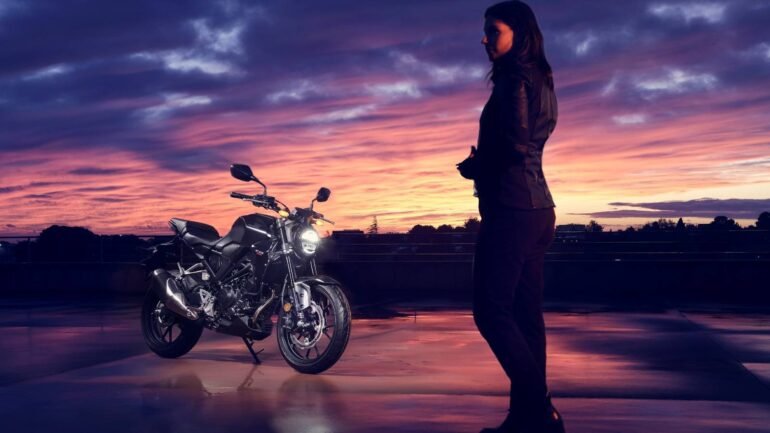
Our pick here is the underrated Honda CB300R. It’s a peppy entry-level neo-retro naked bike that will happily take on anything you throw at it. Its key duty, though, is to be an impeccable commuter. And it excels at that by not only promising comfort, but also ensuring a fuel efficiency of 71 miles per gallon (claimed by Honda). Having used the same engine in a CBR for half a decade, I can happily report the engine is capable of way more than that as well. A personal record for me is close to 85 miles per gallon in city riding conditions with an easy right wrist.

The next best comes as a surprise: the NC750X. We say surprise because this is essentially a middleweight motorcycle with a 745cc, parallel-twin engine. But the mill is extremely understressed, producing entry-level levels of performance. That helps it manage an impressive 67 miles per gallon (claimed by Honda). Another party trick here is the automatic transmission. Unlike the usual manual six-speed setup, you get a dual-clutch six-speed unit that eliminates manual shifting. There are three modes for the DCT, in addition to paddle shifters for manual control.

Tied with the NC is another underrated naked bike: the Honda CB500F. It matches the NC’s claimed mileage (67 miles per gallon), albeit with a smaller capacity engine. Here, you get Honda’s popular 471cc parallel-twin engine, also present on the NX500, Rebel 500, and CBR500R. It edges the other two in terms of claimed mileage, though, probably thanks to its lower weight. It also promises to be a better commuter than its siblings, with upright and neutral ergonomics. You might argue the Rebel would offer more comfort, but the CB has a much bigger tank and weighs the same as the cruiser.
Fuel-Saving Honda Commuter Bikes
- CB300R
- NC750X
- CB500F
- Rebel 500
The CB300R Boasts A Proven 286cc Single-Cylinder Engine
Power: 30 HP

Credit for the impressive mileage undeniably goes to the CB300R’s powerhouse. It’s a 286cc, liquid-cooled single-cylinder mill based on the CBR250R that debuted almost 15 years ago. With a bigger bore and internal changes, the CB boasts 30 horsepower and 20 pound-feet. That isn’t a lot, and the naked is clearly inferior to its rivals like the BMW G 310 R and the Yamaha MT-03. But the CB makes up for that with its extremely low 316-pound curb weight.
That gives it a power-to-weight ratio of 0.094-HP/pound, which is the same as the more powerful G 310 R. All that power is sent to the wheel via a six-speed transmission, enabling a top speed of 93 miles per hour (speedo-indicated). As for range, you’re looking at around ~190 miles in ideal conditions. Owners find the small tank the biggest pain with the CB.
2025 CB300R Engine Specs
|
Capacity |
286cc |
|
Layout |
Single-cylinder |
|
Power |
30 HP @ 9,000 RPM |
|
Torque |
20 LB-FT @ 7,750 RPM |
|
Transmission |
Six-speed |
|
Fuel efficiency |
71 MPG |
|
Top speed |
93 miles per hour |
Honda’s Diamond Chassis And Showa Suspension Ensure Easy-Going Riding Dynamics
Topped With A Low Seat And Straight Handlebars

You already know the CB is uber light. And the credit for that primarily goes to its underpinnings. Under the skin lies Honda’s diamond chassis, carved from steel and paired with a double-sided swingarm. Showa USD forks and monoshock join hands for a pliant ride, where only the rear has adjustment. As for braking, each end features single disc brakes, mounted onto a 17-inch alloy wheel. Oh, and ABS is standard equipment here, which is a rare thing from Honda!

With all that, you’ll also appreciate the ergonomics. The seat is low at 31.6 inches, the pegs are mid-set, and the handlebars are flat-ish. That ensures an upright riding posture, with the indented tank helping you tuck your legs. Just know that this is an uber-minimalistic bike overall, so if you have a big build, this will look tiny under you. I’m speaking from experience!

Another thing to keep in mind is the overall simplicity. The baby CB shows its age in the features department, as you only get an LCD instrument cluster, LED lights, and ABS. It’s primarily because Honda hasn’t updated the CB ever since its debut. There doesn’t seem to be a plan for that either, as the CB currently stands discontinued in many leading markets like Europe, Britain, and India. Enjoy it in the US while you can!
2025 CB300R Underpinnings And Dimensions
|
Chassis |
Steel diamond |
|
Front suspension |
Showa USD forks |
|
Rear suspension |
Showa monoshock |
|
Wheels |
17/17-inch alloys |
|
Brakes |
Single disc brakes front and rear |
|
Wheelbase |
53.2 inches |
|
Weight |
316 pounds (wet) |
|
Seat height |
31.6 inches |
|
Ground clearance |
7.1 inches |
|
Fuel tank capacity |
2.6 gallons |