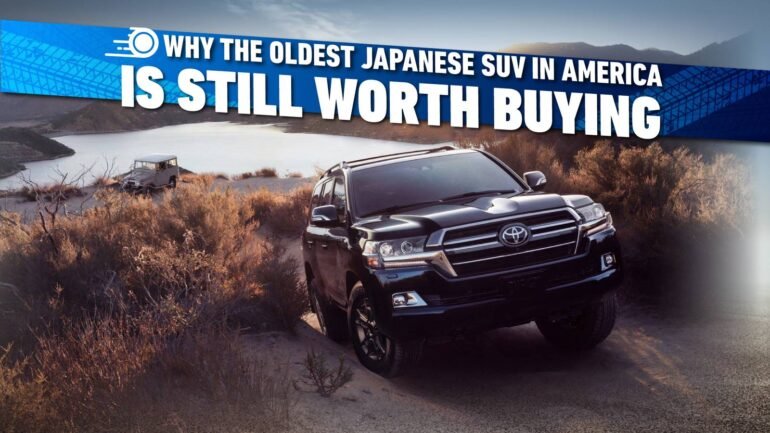
When people talk about motoring icons, the Toyota Land Cruiser isn’t just somewhere on the list; it’s a staple on nearly all great automotive lists. In America, where the SUV has grown into the default family car, the Land Cruiser stands apart as something much bigger than a means of getting from A to B. It’s the oldest Japanese SUV sold in the United States, with a lineage that stretches back to the Eisenhower years, and it’s built a reputation not just on luxury or looks, but on durability, performance, and staying power that few vehicles ever earn.

- Base Trim Engine
-
2.4L Turbo Hybrid
- Base Trim Transmission
-
8-speed automatic
- Base Trim Drivetrain
-
Four-Wheel Drive
- Base Trim Fuel Economy (city/highway/combined)
-
22/25/23 MPG
- Base Trim Battery Type
-
Lead acid battery
- Make
-
Toyota
- Model
-
Land Cruiser
- Segment
-
Full-Size SUV
Today, the Land Cruiser name may not carry the same showroom traffic as a Toyota RAV4 or Highlander, but ask anyone who’s owned one—and kept it for 20 years without issue—why they still love their old Land Cruiser, and you’ll get it. This isn’t just another SUV. These trucks carved out a life here long before SUVs were trendy. And in its latest form, the Land Cruiser proves that its relevance is not nostalgia alone, but still evolving.
To provide the most accurate and up-to-date information, this article uses data sourced from various manufacturers and authoritative sources.
A Brief History Of The Land Cruiser In America

The Land Cruiser first arrived in the U.S. in 1958, imported in tiny numbers at a time when Toyota itself was just a curiosity to American buyers. The model that hit U.S. shores was the FJ25, a simple, Jeep-like off-roader with agricultural roots. It was rugged, utilitarian, and, frankly, not all that comfortable—but it worked. What mattered was that it didn’t break, even when pushed hard, and that was exactly the type of reputation Toyota needed.
Through the 1960s and 1970s, the Land Cruiser FJ40 became the face of Toyota in America. With its boxy body, round headlights, and go anywhere attitude, the FJ40 didn’t just compete with Jeeps—it established Toyota as a company capable of building vehicles that last. In fact, in some rural parts of the U.S., the FJ40 was the first Toyota many buyers ever saw, and it left a lasting impression.
Adding Family-Friendly Elements To The Formula

By the 1980s, the Land Cruiser evolved into something larger, with the 60 Series (and later 80 Series) blending the go-anywhere ability with more family-friendly space. Air conditioning, power windows, and automatic transmissions became part of the mix. This evolution mirrored the broader rise of SUVs in America. While the FJ40 was about surviving rough terrain, the 60 and 80 Series Land Cruisers were about doing it with comfort and consistency—without losing Toyota’s legendary reliability.
By the time the 100 Series Land Cruiser landed in the late 1990s, Toyota had positioned it as a luxury SUV just as the Lexus brand was taking off. Buyers saw the Land Cruiser as the Japanese answer to the Range Rover: upscale, capable, and practically unbreakable. It was never a big seller—partly because Toyota didn’t flood the market with them—but those who bought one rarely traded it for anything else.
The Modern Land Cruiser: 200 Series And Beyond

Fast-forward to the late 2000s and 2010s, and we arrive at the 200 Series Land Cruiser, sold in the U.S. from 2008 through 2021. This was the longest-running Land Cruiser generation in America, and it’s the version many enthusiasts still see as peak Land Cruiser: body-on-frame toughness, a smooth 5.7-liter V8, and every comfort feature you could want. It wasn’t cheap—north of $80,000 in its later years—but that was kind of the point.
The 200 Series wasn’t about affordability; it was about dependability and luxury at any price. Owners valued the way it could tow, handle rough trails, or simply shuttle the family in comfort while never feeling fragile. When Toyota announced it was pulling the Land Cruiser from the U.S. after the 2021 model year, used values spiked. People scrambled to grab one before they disappeared. That kind of loyalty doesn’t happen by accident.
A Capable And Efficient LC For The Modern Age

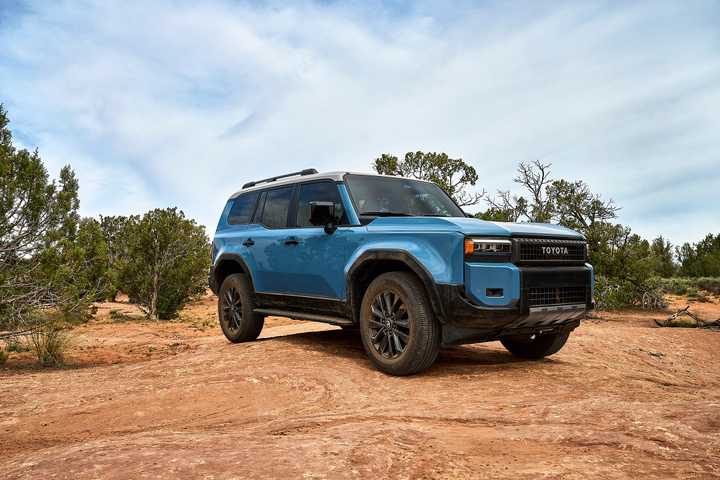
Now, for 2024 and 2025, the Land Cruiser is back in a slightly different form. Built on Toyota’s TNGA-F platform (shared with the Lexus GX and new Sequoia), the latest Land Cruiser goes back to its roots in some ways. Instead of a V8, it uses a hybridized 2.4-liter turbo-four making 326 horsepower and 465 pound-feet of torque. It’s more efficient, lighter, and aimed at being more accessible to a broader audience. For some, the loss of the big V8 feels like the end of an era, but for others, the return of the Land Cruiser name at a lower starting price is exactly what’s needed to keep the legend alive in America.
Why People Still Love The Land Cruiser

So what makes the Land Cruiser—be it an old FJ40, a 200 Series, or the brand-new 2025 model—still worth buying in America? A few things stand out:
- Legendary Reliability: Toyota has built its entire reputation around dependability, but the Land Cruiser takes it up a notch. These SUVs are engineered to last decades, not years. It’s not uncommon to see 200 Series Land Cruisers running strong with 250,000 miles on the clock and minimal mechanical issues. For families who don’t want to play the trade-in game every five years, that matters.
- Real Off-Road Capability: Unlike many “SUVs” today that are really just tall crossovers, the Land Cruiser remains body-on-frame with real off-road hardware. Locking differentials, crawl control, and terrain select modes aren’t marketing gimmicks—they work. This is a vehicle you can actually take into the mountains or across the desert, and it won’t complain.
- Timeless Appeal: Styling may evolve, but the Land Cruiser has never tried to chase trends. From the boxy FJ40 to the understated 200 Series, these SUVs look purposeful rather than flashy. The new 2025 Land Cruiser leans into retro cues with squared lines and simple shapes, which resonate with buyers who miss the no-nonsense look of older SUVs.
- Strong Resale Value: Because the Land Cruiser is relatively rare in the U.S. and has such a loyal following, resale values are consistently high. In fact, used Land Cruisers often sell for more than you’d expect, even after a decade of use. That means buying one isn’t just about owning a dependable vehicle—it’s also about parking money in something that holds its value.
- A Cult Following: Few SUVs inspire communities the way the Land Cruiser does. Whether it’s forums, off-road clubs, or restoration shops, the Land Cruiser community is passionate, welcoming, and global. Owning one often feels like joining a family.
The Land Cruiser Today: Still Worth It?
The newest Land Cruiser is a different kind of proposition. It’s smaller than the Sequoia, more affordable than the Lexus LX, and more efficient than the 200 Series ever was. At around $55,000 to start, it’s positioned as a premium off-roader that doesn’t break into luxury-car pricing, which makes it a smart buy for families who want capability without going full Range Rover.
Yes, purists will miss the V8. But Toyota’s decision to bring back the Land Cruiser in hybrid form makes sense. It lowers emissions, saves fuel, and keeps the model competitive in a market that cares more about efficiency than displacement. Plus, with 465 pound-feet of torque, it’s not exactly slow.
Power from the turbocharged engine is abundant, but it’s best appreciated while already at speed, at which point pick-up acceleration is quick and swift.
– William Clavey, TopSpeed Editor-at-Large
What hasn’t changed is the essence of the Land Cruiser: it’s still overbuilt, still designed to last, and still carries the weight of history as the oldest Japanese SUV in America. For buyers who want more than just another crossover, that heritage means something.
TopSpeed’s Thoughts: Land Cruiser Is More Than Just An SUV

The Toyota Land Cruiser has been part of American roads (trails) for nearly seven decades, from the barebones FJ25 in 1958 to the plush 200 Series V8s of the 2010s and now the hybrid-powered 2025 model. Through all those changes, one thing has remained constant: its reputation as a vehicle you can trust, whether you’re driving across the city or across the continent.
It’s not the flashiest SUV, nor the cheapest, but that’s never been the Land Cruiser’s role. It’s about building something that lasts, delivering confidence in any condition, and offering a sense of tradition in a market that constantly chases the next big thing.
So, is the Toyota Land Cruiser still worth buying in 2025? Absolutely. If you value durability, off-road pedigree, and a legacy that no other Japanese SUV in America can match, the Land Cruiser is more than just an old nameplate. It’s still the standard.