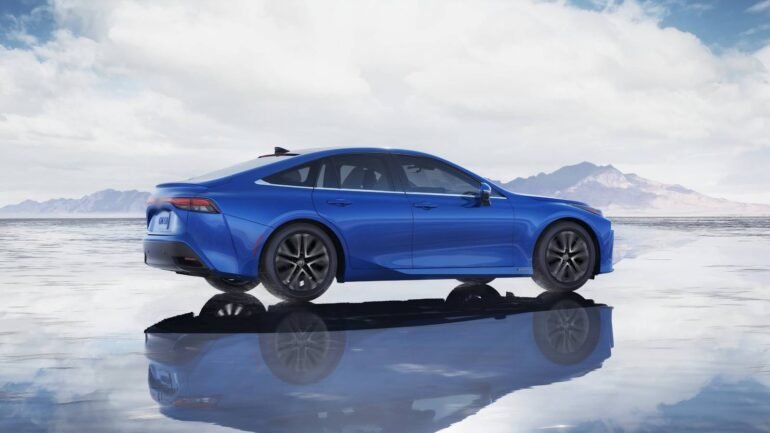
When it comes to value retention, very few cars perform as well as those from the Toyota stable. The Japanese brand benefits from a long history of fuel efficiency and dependability, making their products exemplary long-term investments. Unfortunately, there is one particular futuristic sedan that the brand currently sells, which struggles with some of the worst depreciation rates that the entire new car market has seen. The current state of hydrogen in the U.S. isn’t looking too great, as manufacturers and governments alike show substantially more interest in electrification.

- Base Trim Engine
-
EV
- Base Trim Transmission
-
Automatic
- Base Trim Drivetrain
-
Rear-Wheel Drive
- Base Trim Horsepower
-
182 HP
- Base Trim Torque
-
221 lb.-ft.
- Base Trim Fuel Economy Equivalent (city/highway/combined)
-
76/71/74 mpge
- Make
-
Toyota
- Model
-
Mirai
- Segment
-
Midsize Sedan
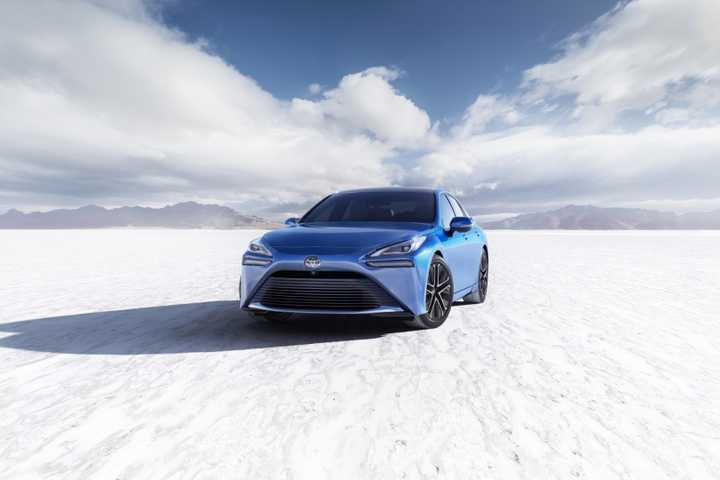
Toyota is one of few companies that remains deeply invested in hydrogen as a fuel source for combustion and fuel cell purposes. Despite its niche market and compromised usability, it continues to produce and sell the Toyota Mirai in California. The Mirai doesn’t have a long-term ownership appeal because of how expensive hydrogen is in the U.S. Because of this, you’ll find that Mirai models typically suffer from bad depreciation rates once Toyota’s complementary hydrogen credit runs out. If you purchase a new Mirai today, you benefit from the brand’s $15,000 fuel credit over six years. Leasing cuts the time down to three years. Thankfully, this is transferable, so the Mirai manages to maintain a lot of value within the first few years of ownership. Considering that this car is essentially free to fuel and maintain, it holds its value substantially better than some fully electric rivals.
To provide you with the most up-to-date and accurate information possible, the data used to compile this article was sourced from various manufacturers and other authoritative sources, including Carbuzz.
The Toyota Mirai Is A Depreciation Disaster
Despite Its Modern Tech, It’s A Nightmare To Own Beyond Five Years

According to iSeeCars, the Toyota Mirai will lose $27,018 or 52.2 percent of its initial purchase value after five years or 60,000 miles, which is about 10 percent worse than its non-FCEV sedan equivalents.
Using CarEdge‘s intuitive valuation tool, we see that the base XLE model loses a staggering $40,079 of its initial purchase value within the first five years and 60,000 miles of ownership. J.D. Power indicates that a two-year-old model tends to sell for around $43,650 and $74,885, based on the specification and condition.

It should come as a surprise to no one that the Mirai is a terrible option for value retention, given how hydrogen continues to become a problematic fuel source for personal mobility. Regardless, the Japanese brand has expressed commitment to this fuel source, which it backs with its latest round of investments and partnerships that aim to improve hydrogen production, storage, and distribution.
Toyota Looks To Ramp Up Production Of Eco-Options

To accelerate adoption, Toyota has invested in major hydrogen projects such as its H2HQ research hub in California and a $139 million joint venture factory in Chengdu, China, both focused on developing cheaper and longer-lasting fuel cell stacks to close the cost gap with battery EVs.
Toyota continues to follow its multi-pathway strategy that integrates hybrids, plug-in hybrids, battery EVs, and hydrogen fuel cells instead of relying on a single solution, unlike most automakers that are currently pushing fully toward battery-electric vehicles. The Japanese brand views hydrogen as essential for achieving zero emissions in sectors where batteries face limitations, such as heavy transport, industrial applications, and high-demand fleet operations. It also expects hydrogen to start replacing diesel within the next decade, offering both environmental and economic benefits.
Pricing Starts At $51,795
You’re Really Better Off Opting For The Leasing Deal

The Toyota Mirai XLE starts its pricing off at $51,795, and discontinues the Limited model for the 2026 model year. Optional extras available for the XLE include premium Elemental Silver, Hydro Blue, and Supersonic Red paint shades for $425, $1,120 20-inch alloy wheels, and a $1,685 Advanced Technology Package, which includes a host of digital and safety features.
Toyota also provides some storage, protection, and pet-friendly accessories via a very comprehensive catalog. The Limited trim used to grant you access to additional interior color schemes at no extra cost. The aforementioned packages were also standard with this derivative.

As we’ve mentioned, there’s a lot of value in leasing a Mirai. For 2026, Toyota doesn’t list its Mirai lease deals on its local website, so the best way to get information regarding this is to contact or visit your local California dealership. Toyota usually makes these deals very attractive towards the end of the model year, with zero APRs over 72 months and comprehensive cash-back packages.
The Toyota Mirai Produces 182 Horsepower
Efficiency Remains A Number One Priority

Despite its dynamic design, the Toyota Mirai is by no means a performance-minded electric car. Efficiency remains the priority, which is why the compact rear-driven electric motor only generates 182 horsepower and 300 pound-feet.
The results in a 9.2-second 0-60 MPH dash and 112 MPH top speed. This is a car that you’ll keep within the confinement of California’s borders, as you won’t be able to find any hydrogen refueling stations outside the state. The model sits on the brand’s TNGA platform, so at least you benefit from some very sharp and comfortable suspension characteristics.
The Toyota Mirai’s EPA Estimates Are Solid

When it comes to efficiency, the Mirai reigns king within its very secluded segment. The EPA estimates that the base XLE trim gets 74 MPGe or 1.4 kg of H2 per 100 miles while covering 402 miles in-between refuels. The Limited trim suffers from a slightly worse 65 MPGe or 1.6 kg H2 per 100 miles estimate because of the larger 20-inch wheels. It will only cover 357 miles on a single tank.
The Toyota Mirai’s Standard Warranty
The Brand Backs Its FCEV Tech

Toyota includes a comprehensive warranty package with all Mirai sales. This includes a 36-month or 35,000-mile basic bumper-to-bumper warranty and a 60-month or 60,000-mile powertrain warranty. The brand will resolve any battery-related faults over an eight-year or 150,000-mile coverage, while FCEV defects benefit from an eight-year or 100,000-mile warranty. You also get 36 months of complimentary roadside assistance and two complementary annual services within a 24-month or 25,000-mile period.
It is unlikely that you’ll ever get to use Toyota’s warranty, as the Mirai proves to be a very trustworthy and reliable FCEV option. The NHTSA currently lists no recalls, investigations, or complaints for the 2024 model year, but the 2023 model year is subject to one recall regarding a faulty rearview camera display and one complaint about the fueling and propulsion system.

FCEVs are generally very reliable options, as they only feature one moving motor that doesn’t require extensive servicing. The fuel cell itself is also a far more robust piece of equipment compared to a full EV battery pack, making it a more mechanically viable option for long-term use.
Understanding The Lack Of Consumer Confidence In FCEVs
Hydrogen Just Loses Popularity Points As Each Year Passes

The Mirai holds its value well over the first few years of ownership, but it pretty much becomes a worthless product once Toyota’s complementary hydrogen fuel lapses. Running the Mirai at your own cost will be a very expensive procedure, as the fuel currently costs $36 per kilogram. The Mirai’s tank holds five kilos of hydrogen, meaning you’ll be spending $180 every 400 miles, which is significantly more expensive than any ICE or EV available on the new car market. Additionally, the Mirai remains a California-only car, further limiting its mass-market appeal and overall value retention.

Toyota may still show deep interest in hydrogen technology, and there have been some announcements regarding significant investments in the fuel source. Unfortunately, the U.S. looks like it is ready to start leaving this complex fuel system in the past unless production, storage, and distribution drastically improve. We’ve already heard news of some hydrogen stations being forced to shut down due to the poor demand for hydrogen cars experienced in California.
Sources: iSeeCars, CarEdge, J.D. Power, the EPA, and the NHTSA.